
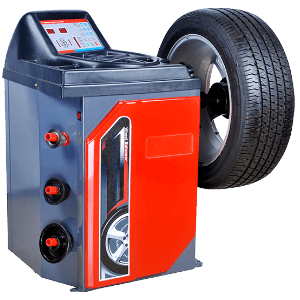
Wheel balancing machine


- Vehicle type: Moto
- Wheel Diameter to [inch]: 21
- Length [mm]: 390
- Width [mm]: 345
- Height: 395
- Weight [kg]: 3.9
- Material: Steel
- Stub Axle Diameter [mm]: 14-28
- Item number: 10-590
- Our price: £137.99
- Manufacturer: NEO TOOLS
- EAN number: 10-590
- Condition: New
price incl. 20% VAT
excl. delivery costs
Sold by AUTODOC
Here you can add a product to compare


- Product line: Gunson Wheel
- Hub Diameter [mm]: 38,1 - 101,6
- Diameter: 301
- Height: 575
- Item number: 77162
- Our price: £146.99
- Manufacturer: Gunson
- EAN number: 5018341771621
- Condition: New
price incl. 20% VAT
excl. delivery costs
Sold by AUTODOC
Here you can add a product to compare


- Number of connectors: 2
- Colour: red
- Cone Size [mm]: <35
- Working height to [mm]: 400
- Item number: VS1819
- Our price: £175.99
- Manufacturer: SEALEY
- EAN number: 5051747443457
price incl. 20% VAT
excl. delivery costs
Sold by AUTODOC
Here you can add a product to compare


- for shaft diameter [mm]: 10 - 25
- Width to [mm]: 320
- Vehicle type: Motorcycle
- Item number: 7WB01
- Our price: £257.99
- Manufacturer: KUNZER
- EAN number: 4260174662404
- Accumulate your bonuses through purchasing items marked “BONUS";
- Pay for up to 10% of your order with the accumulated bonuses;
price incl. 20% VAT
excl. delivery costs
Sold by AUTODOC
Here you can add a product to compare


- Number of connectors: 2
- Wheel Diameter [mm]: 12-33
- Width from [mm]: 200
- Width to [mm]: 310
- Product line: POCKET WHEEL BALANCE
- Item number: 60170401411
- Our price: £57.99
- Manufacturer: Hi-Q Tools
- EAN number: 4053873164948
- Condition: New

- Number of connectors: 2
- Wheel Diameter to [inch]: 27
- Width from [mm]: 270
- Width to [mm]: 350
- Cone Size [mm]: 12-33
- Item number: 60170401410
- Our price: £96.99
- Manufacturer: Hi-Q Tools
- EAN number: 4053873116435
- Condition: New


- Alternating Current [V]: 220
- Rim Size [inch]: 10-24
- Rim Width [inch]: 1,5-18
- Quick-change adapter diameter [mm]: 40
- Weight [kg]: 117
- Item number: T-670
- Our price: £972.99
- Manufacturer: TCE
- Condition: New

- Alternating Current [V]: 220
- Max. wheel weight to [kg]: 70
- Rim Size [inch]: 10-24
- Service Speed [1 / min]: 180
- Quick-change adapter diameter [mm]: 40
- Weight [kg]: 118
- Rim Width [inch]: 1,5-20
- Item number: T-660
- Our price: £1,265.00
- Manufacturer: TCE
- Condition: New


- Wheel Diameter to [inch]: 24
- Item number: HST 955B
- Our price: £1,413.00
- Manufacturer: HST
- EAN number: 5906125083407
- Condition: New

- Alternating Current [V]: 220
- Max. wheel weight to [kg]: 70
- Rim Size [inch]: 10-24
- Service Speed [1 / min]: 180
- Quick-change adapter diameter [mm]: 40
- Weight [kg]: 188
- Item number: T-650
- Our price: £1,779.00
- Manufacturer: TCE
- Condition: New


- Weight [kg]: 78
- Width [mm]: 1165
- Height: 1270
- Depth [mm]: 887
- Rim Diameter from [inch]: 8
- Rim Diameter to [inch]: 26
- Rim Width from [inch]: 2
- Rim Width to [inch]: 19
- Voltage [V]: 230
- Number of connectors: 1
- Mains frequency [Hz]: 60 Hz
- Item number: 1 694 100 553
- Our price: £2,661.00
- Manufacturer: BOSCH DIAGNOSTICS
- EAN number: 2503001556395
- Condition: New

- Weight [kg]: 78
- Width [mm]: 1165
- Height: 1270
- Depth [mm]: 887
- Rim Diameter from [inch]: 8
- Rim Diameter to [inch]: 26
- Rim Width from [inch]: 2
- Rim Width to [inch]: 19
- Voltage [V]: 230
- Number of connectors: 1
- Mains frequency [Hz]: 60 Hz
- Item number: 1 694 100 557
- Our price: £2,912.00
- Manufacturer: BOSCH DIAGNOSTICS
- EAN number: 2503001556401
- Condition: New

- Weight [kg]: 78
- Width [mm]: 1165
- Height: 1270
- Depth [mm]: 887
- Rim Diameter from [inch]: 8
- Rim Diameter to [inch]: 26
- Rim Width from [inch]: 2
- Rim Width to [inch]: 19
- Voltage [V]: 110
- Number of connectors: 1
- Mains frequency [Hz]: 60 Hz
- Item number: 1 694 100 204
- Our price: £2,948.00
- Manufacturer: BOSCH DIAGNOSTICS
- EAN number: 2503001555589
- Condition: New

- Weight [kg]: 78
- Width [mm]: 1165
- Height: 1270
- Depth [mm]: 887
- Rim Diameter from [inch]: 8
- Rim Diameter to [inch]: 26
- Rim Width from [inch]: 2
- Rim Width to [inch]: 19
- Voltage [V]: 230
- Number of connectors: 1
- Mains frequency [Hz]: 50 Hz
- Item number: 1 694 100 219
- Our price: £3,347.00
- Manufacturer: BOSCH DIAGNOSTICS
- EAN number: 2503001555725
- Condition: New

- Weight [kg]: 80
- Width [mm]: 1165
- Height: 1450
- Depth [mm]: 1000
- Rim Diameter from [inch]: 8
- Rim Diameter to [inch]: 26
- Rim Width from [inch]: 2
- Rim Width to [inch]: 16
- Voltage [V]: 110
- Number of connectors: 1
- Mains frequency [Hz]: 50 - 60 Hz
- Item number: 1 694 100 205
- Our price: £3,439.00
- Manufacturer: BOSCH DIAGNOSTICS
- EAN number: 2503001555596
- Condition: New

- Weight [kg]: 80
- Width [mm]: 1165
- Height: 1450
- Depth [mm]: 1000
- Rim Diameter from [inch]: 8
- Rim Diameter to [inch]: 26
- Rim Width from [inch]: 2
- Rim Width to [inch]: 16
- Voltage [V]: 110
- Number of connectors: 1
- Mains frequency [Hz]: 50 - 60 Hz
- Item number: 1 694 100 187
- Our price: £3,538.00
- Manufacturer: BOSCH DIAGNOSTICS
- EAN number: 2503001555503
- Condition: New

- Weight [kg]: 78
- Width [mm]: 1165
- Height: 1270
- Depth [mm]: 887
- Rim Diameter from [inch]: 8
- Rim Diameter to [inch]: 26
- Rim Width from [inch]: 2
- Rim Width to [inch]: 19
- Voltage [V]: 230
- Number of connectors: 1
- Mains frequency [Hz]: 60 Hz
- Item number: 1 694 100 561
- Our price: £3,875.00
- Manufacturer: BOSCH DIAGNOSTICS
- EAN number: 2503001556418
- Condition: New

- Rim Width from [inch]: 1
- Rim Width to [inch]: 20
- Rim Diameter from [inch]: 10
- Rim Diameter to [inch]: 26
- Max. wheel weight to [kg]: 70
- Voltage [V]: 230
- Number of connectors: 1
- Mains frequency [Hz]: 50 - 60 Hz
- Item number: 1 694 100 000
- Our price: £4,061.00
- Manufacturer: BOSCH DIAGNOSTICS
- EAN number: 2503001555046
- Condition: New

- Colour: green
- Rim Width from [inch]: 1
- Rim Width to [inch]: 20
- Rim Diameter from [inch]: 10
- Rim Diameter to [inch]: 26
- Max. wheel weight to [kg]: 70
- Voltage [V]: 230
- Number of connectors: 1
- Mains frequency [Hz]: 50 - 60 Hz
- Item number: 1 694 100 285
- Our price: £4,152.00
- Manufacturer: BOSCH DIAGNOSTICS
- EAN number: 4047025564113
- Condition: New

- Weight [kg]: 80
- Width [mm]: 1165
- Height: 1450
- Depth [mm]: 1000
- Rim Diameter from [inch]: 8
- Rim Diameter to [inch]: 26
- Rim Width from [inch]: 2
- Rim Width to [inch]: 16
- Voltage [V]: 230
- Number of connectors: 1
- Mains frequency [Hz]: 50 - 60 Hz
- Item number: 1 694 100 186
- Our price: £4,363.00
- Manufacturer: BOSCH DIAGNOSTICS
- EAN number: 2505820190637
- Condition: New
Wheel balancing machine: useful information about tools for your car in our blog
Wheel balancing machine: what you need to know
Wheel Balancing Machines: Tips for Buying and Using Them Correctly
A wheel balancing machine is used to statically and dynamically balance vehicle wheels. This ensures smooth running and driving safety on the road by compensating for differences in mass. Choosing the right model depends largely on how often you change wheels, the wheel size, and the required measurement accuracy, as an incorrect selection leads to inefficient work processes.
How a Wheel Balancing Machine Works
The following explains how these machines are constructed so that you can better understand how they work when mounting wheels.
A balancing machine puts the wheel into a controlled rotation and measures the out-of-balance forces using piezoelectric force sensors. The values determined for the size and position of the necessary balancing weights are calculated electronically and displayed on the screen. The wheel can then be precisely balanced by sticking or hammering on clip-on wheel weights.
The drive technology plays a central role in the design of the wheel balancing machine, with modern systems reaching high speeds in a short time thanks to powerful motors to increase measurement accuracy. The wheel is clamped using a central shaft fitted with various cone adapter sets to ensure the rim is accurately centred on the mount.
The electronics process the sensor data in real-time and often offer programs for different rim types, such as steel or aluminium, which require different positions for attaching the weights. When working with automotive components, it is also important to note that the wheels must be correctly mounted on the vehicle after balancing. This must be done with a torque wrench according to the manufacturer's specifications to ensure operational safety.
Types of Wheel Balancing Machines
Choosing the right type of machine depends on the intended use and the degree of automation required in the workshop.
| Type | Advantages / Application Focus | Typical Limitations |
|---|---|---|
| Manual Wheel Balancing Machine | Inexpensive to purchase; suitable for occasional use with small wheel sets | Time-consuming; lower precision on large rims |
| Digital Wheel Balancing Machine | Fast data acquisition; display of weight position on the monitor; standard in workshops | Requires calibration; sensitive sensor technology |
| Wheel Balancing Machine with Sonar Measurement | Automatic detection of rim width using laser/sonar; reduces manual input errors | Higher price; more complex maintenance of the measuring optics |
| Stationary Car Wheel Balancing Machine | High shaft rigidity; designed for all common car tyre sizes | Not suitable for HGV wheels; takes up space in the workshop |
| HGV Wheel Balancing Machine | Stable mount for heavy, large wheels with high weight; reinforced shaft | Large footprint; unwieldy with small car wheels |
| Mobile Wheel Balancing Machine | Flexible location due to compact design; for seasonal business or on-site service | Lower load capacity; fewer additional functions |
Manual or simple digital balancing machines are often sufficient for occasional users or small businesses. Professional workshops with a high daily throughput, on the other hand, should invest in devices with sonar measurement to increase work efficiency.
Advantages and Limitations of the Wheel Balancing Machine
Here, the advantages and disadvantages of the various systems are compared.
Compared to manual balancing, the machine enables precise identification of imbalances, which is essential for smooth steering and the maintenance of suspension components.
Advantages of the Wheel Balancing Machine
- Precision – exact determination of the number of grams needed to eliminate vibrations.
- Efficiency – significant time savings when determining the correct weight position on the wheel.
- Safety – prevents uneven tyre wear and reduces stress on wheel bearings and suspension.
- Versatility – various programs for different rim geometries, such as adhesive weights behind spokes.
Disadvantages of the Wheel Balancing Machine
- Maintenance – regular calibration of the sensors is essential for correct measurement results.
- Space requirements – requires a fixed, level surface and sufficient space for wheel movement.
- Purchase costs – professional devices with automatic measurement require a larger investment.
- Accessory dependence – specific centring cones are necessary for different wheel bolt patterns.
How Much Does a Wheel Balancing Machine Cost?
Pricing varies depending on the features and technical standard.
| Product Group | Approximate Range | Price Drivers |
|---|---|---|
| Entry-Level Models | approx. £800–£1,500 | Manual input, simple electronics |
| Semi-Professional Devices | approx. £1,500–£3,500 | Digital display, automatic wheel measurement |
| Professional Workshop Systems | approx. £3,500–£8,000 | Sonar technology, touch display, high measuring speed |
| HGV Wheel Balancing Machines | approx. £4,000–£10,000 | Material strength, balancing capacity, force sensors |
The degree of automation in the measurement and the quality of the sensors are major price drivers. Manufacturers such as Hofmann, Corghi, or Beissbarth offer durable options here.
For price-conscious users, entry-level models are often appropriate for private use, while professional systems are the more economical choice for workshops with a high volume of wheel changes due to their efficiency.
Where is a Wheel Balancing Machine Used?
The areas of application cover all areas where the driving quality of wheels plays a role.
- Automotive Workshops: Here, the balancing machine is in daily use to professionally treat wheels after mounting or if there is running instability. It ensures that customers receive vehicles with optimally balanced tyres.
- Tyre Service Providers: Tyre changing is the main focus in these businesses, which is why high-performance devices with automatic measurement and fast cycle times are used here.
- Industrial Assembly Plants: Manufacturers of wheels and tyres use the devices to check the quality specifications during production and to directly correct any impermissible imbalances.
- DIY Workshops with an Automotive Focus: Ambitious mechanics invest in compact models to carry out wheel changes themselves, whereby the safety of wheel bolt mounting must always be ensured with a torque wrench.
How Do I Choose the Right Wheel Balancing Machine?
The machine should be selected based on individual requirements and throughput.
| Criterion | What to Check | Relevant for |
|---|---|---|
| Rim Capacity | Maximum diameter and width of the wheel | All Models |
| Measurement Automation | Sonar or laser input instead of manual data entry | High Throughput |
| Ease of Use | Display type (monitor vs. LED), menu navigation, touch function | High-Volume Users |
| Calibration Effort | How easy is self-calibration? | Maintenance |
| Space Requirements | Footprint and necessary swivel range of the protective hood | Small Workshops |
The most important criterion is the efficiency of data acquisition. Workshops should opt for automatic measurement systems for high throughput, while simple digital devices are usually sufficient for occasional users.
Correct Use, Care, and Storage of the Wheel Balancing Machine
Proper maintenance significantly extends the life of the hardware.
Technology and Common Errors with Wheel Balancing Machines
A common error is not cleaning the rim contact surface or the centring mount properly, which leads to a runout and thus incorrect measurements.
In the automotive sector, the specifications of the material and vehicle manufacturer apply to gluing and sealing work; curing times, surface preparation, and temperature windows must not be shortened.
Correct technique includes always centring the wheel with the appropriate cone and tightening the quick-release fastener firmly. Electrical safety is essential here; as this is a mains-operated device, an undamaged connection to a properly earthed socket is required.
- Cleaning Interval: The centring mount must be freed from dirt and brake dust after each wheel.
- Weight Position: Pay close attention to attaching the weights precisely at the point indicated by the device.
- Safety Distance: No one may be in the danger zone during rotation; the protective hood must always be closed.
- Wheel Mounting: The balancing process is complete, but safety on the wheel itself requires tightening the wheel bolts with a torque wrench.
- Calibration: Regularly run the machine's calibration program according to the manual.
Care and Storage of the Wheel Balancing Machine
The machine must stand dry and on an absolutely level surface, as vibrations or moisture can permanently damage the sensitive sensors.
If not used for a long time or in dusty workshop environments, it is advisable to cover sensitive components such as the shaft to prevent contamination.
- Cover: Use a protective hood during longer breaks to prevent dust from entering the measuring shaft.
- Sensors: Do not touch the sensors or lasers with oily fingers to avoid deposits.
- Accessory Management: Centring cones should be stored on a special stand to prevent damage that could distort the balancing result.
- Cable Inspection: Regularly check the power cable for kinks or insulation damage.
- Moisture Control: Store the device in a dry workshop environment to prevent corrosion on the shaft.
Useful Accessories for the Wheel Balancing Machine
Additional components can further optimise work processes in the workshop.
- Centring Cone Set: Essential for various wheel bolt patterns.
- Weight Pliers: For precise application and removal of clip-on wheel weights.
- Wheel Lift: Supports clamping heavy HGV or SUV wheels.
- Calibration Weight: Enables quick self-testing of the measurement accuracy.
- Cleaning Spray: For preparing the rim before sticking on the weights.
- Safety Glasses: When using compressed air to clean the mount.
- Torque Wrench: Essential for the subsequent mounting of the balanced wheels on the vehicle.
Buy a Wheel Balancing Machine at AUTODOC
The range includes wheel balancing machines and suitable accessories from well-known manufacturers. The filter functions can be used to search specifically by wheel size, machine type, and functions.
Qualified specialist advisors provide support in selecting the right model for individual requirements. Thanks to an efficient delivery network in Europe, the order reaches the customer in a short time and enables an efficient start in the workshop.
Frequently Asked Questions
Why does the balancing machine still show an imbalance after the first run?
This may be due to inaccurate centring of the wheel or the use of the wrong cone. Also, check whether the rim is completely clean and free of encrustations on the contact surface.
How often does the wheel balancing machine need to be calibrated?
It is recommended to calibrate monthly if heavily used, or every time the ambient temperature changes. Each device has a built-in calibration program that usually requires a special test body.
Can I also balance motorcycle wheels with a car balancing machine?
This is only possible with special adapter kits that allow precise mounting of the narrower motorcycle axles. A standard car shaft is generally not directly suitable for motorcycle rims.
Are all balancing machines suitable for light alloy rims?
Most modern machines have special programs for alloy wheels, which take the mounting position of the adhesive weights into account. Check beforehand whether your model has appropriate modes for different rim geometries.
What is the advantage of automatic rim measurement?
Automatic measurement using a laser or sonar reduces manual input errors and significantly speeds up the measuring process. This is particularly crucial for economical working methods with a high volume of wheel changes.