Table of Contents
 1 August 2025 (updated)
 What voltage is a car battery?| Full voltage guide & how to check
Your car battery provides the electrical power needed to start your engine and run everything from headlights to radio. Voltage, the electrical pressure that pushes current through your vehicle's systems, has to stay within specific ranges for optimal operation. Understanding your battery's voltage can help you to diagnose issues and prevent unexpected breakdowns. Here's what you need to know about checking and maintaining proper voltage.
Sold by AUTODOC Sold by AUTODOC Sold by AUTODOC Sold by AUTODOC
 Article number: YBX9096
£151.49price incl. 20% VAT, free delivery
Article number: YBX9096
£151.49price incl. 20% VAT, free delivery
 Article number: YBX9012
£126.49price incl. 20% VAT, free delivery
Article number: YBX9012
£126.49price incl. 20% VAT, free delivery
 YUASA Battery
12V 65Ah 600A EFB Battery
Article number: YBX7027
£104.49price incl. 20% VAT, free delivery
-51%
YUASA Battery
12V 65Ah 600A EFB Battery
Article number: YBX7027
£104.49price incl. 20% VAT, free delivery
-51%
 Article number: 6EK 001 559-001
compared to
RRP
£166.28
£80.99price incl. 20% VAT, excl. delivery costs
Article number: 6EK 001 559-001
compared to
RRP
£166.28
£80.99price incl. 20% VAT, excl. delivery costs

What voltage is a car battery?
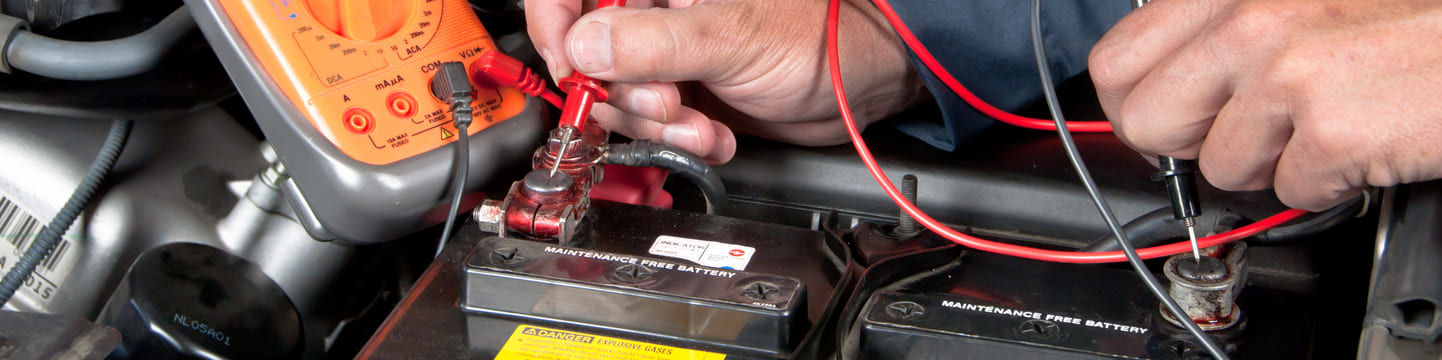
A standard car battery, commonly referred to as a “12-volt battery”, measures around 12.6 volts with the engine off when fully charged. During normal operation, a vehicle's charging system maintains battery voltage between 13.7 and 14.7 volts while the engine is running. If your battery drops below 12.4 volts when resting, it's becoming discharged. At 12.0 volts, it's only about 25% charged, and below 11.8 volts indicates a critically low charge requiring immediate attention.
Recommended Article
Why does my car battery keep dying? Causes, signs, and what to do
The car battery voltage chart below shows what different voltage measurements with the engine switched off mean for the condition of your battery.
Car battery voltage chart (at rest, engine off)
|
Battery voltage
|
State of charge
|
Condition
|
|---|---|---|
| 12.70–12.80 V | 100% | Fully charged (ideal) |
| 12.50–12.69 V | 90–99% | Healthy charge |
| 12.40–12.49 V | 75–89% | Still good, slightly discharged |
| 12.20–12.39 V | 50–74% | Half charged – consider recharging |
| 12.00–12.19 V | 25–49% | Low charge – recharge soon |
| 11.80–11.99 V | 0–24% | Very low – risk of sulfation |
| < 11.80 V | 0% | Deeply discharged – battery may be damaged |
The following table shows what measurements when the engine is switched on mean:
Car battery voltage – engine running (alternator charging)
|
Battery voltage
|
Charging condition
|
|---|---|
| 13.7–14.7 V | Normal charging voltage |
| 14.8 V | Overcharging – may damage battery |
| 13.6 V | Undercharging – check alternator |
What voltage a car battery should be
If you’re wondering “What should my car battery voltage be?”, you need to distinguish between the voltage when the engine is running and resting. A healthy car battery should have a voltage of between 12.4 and 12.7 volts when the engine is off and the car has been at rest for a few hours. When the engine is running, the alternator typically increases the voltage within the range of 13.7 and 14.7 volts in order to recharge the battery.
If your battery reads below 12.4 volts while at rest, it may be undercharged or failing.
Recommended Article
What is a start stop battery? Test, cost, lifespan
Normal battery voltage when car is off
As mentioned above, a properly functioning car battery should have a car battery resting voltage of between 12.4 and 12.7 volts when the engine has been switched off for several hours. According to Haynes, the resting voltage should ideally not be lower than 12.6V. Readings below 12.4 volts suggest the battery is partially discharged, while anything under 12.0 volts indicates significant discharge requiring attention. The exact reading can vary slightly with temperature; colder conditions may result in slightly lower voltage readings.
Normal battery voltage when car is running
The car battery voltage when running should rise to between 13.7 and 14.7 volts. This higher voltage indicates that the alternator is charging the battery properly. If the voltage consistently reads below 13.5 volts while the engine is running, this suggests that your charging system may be underperforming. On the other hand, readings above 14.8 volts could indicate overcharging, which might damage the battery over time. Modern vehicles with computer-controlled charging systems may show slight variations but should generally maintain voltage within this range during normal operation.
Recommended Article
What car battery do I need: Type, size, weight, and voltage
Fully charged car battery voltage
A car battery fully charged voltage, with the engine switched off, should measure approximately 12.6 volts. When the engine is running, the alternator recharges the battery, so the voltage reading will be higher, measuring from 13.5 to 14.5 volts. If your battery consistently reads below 12.4 volts when not in operation, it's likely not holding a full charge and may need charging or replacement.
Sold by AUTODOC Sold by AUTODOC Sold by AUTODOC Sold by AUTODOC Sold by AUTODOC
 Article number: YBX9115
£170.99price incl. 20% VAT, free delivery
Article number: YBX9115
£170.99price incl. 20% VAT, free delivery
 BOSCH Battery Relay
12V
Article number: 0 333 300 003
£296.50price incl. 20% VAT, free delivery
BOSCH Battery Relay
12V
Article number: 0 333 300 003
£296.50price incl. 20% VAT, free delivery
 Article number: 44B19L
£122.99price incl. 20% VAT, excl. delivery costs
Article number: 44B19L
£122.99price incl. 20% VAT, excl. delivery costs
 Article number: 625012072A742
£202.50price incl. 20% VAT, free delivery
Article number: 625012072A742
£202.50price incl. 20% VAT, free delivery
 Article number: 640SHD
£138.49price incl. 20% VAT, excl. delivery costs
Article number: 640SHD
£138.49price incl. 20% VAT, excl. delivery costs
How to check car battery voltage
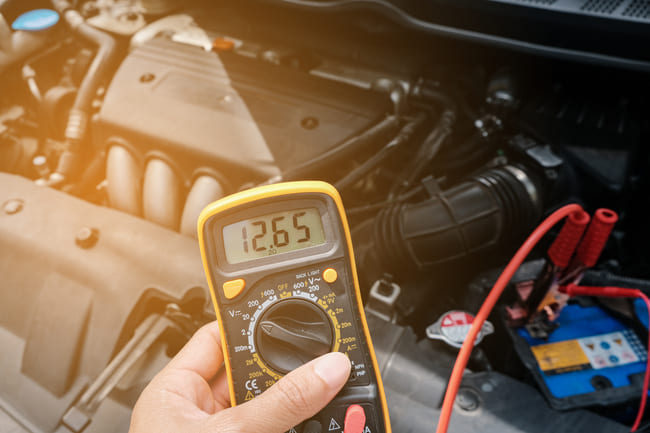
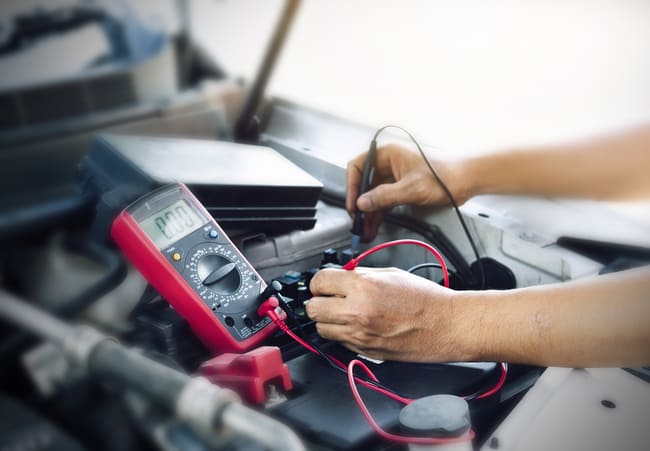
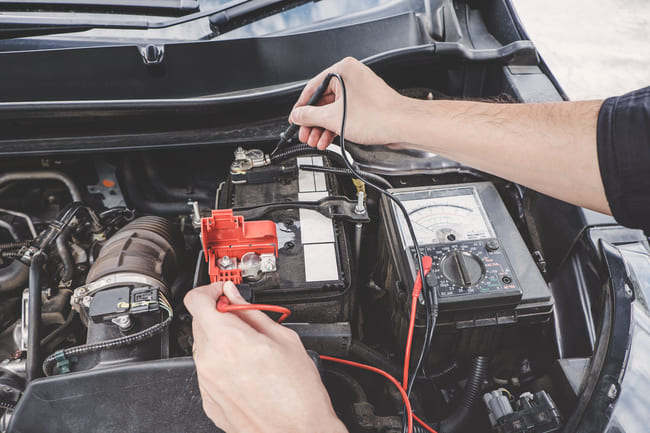
AUTODOC technicians emphasise that regularly checking the voltage is an important part of car battery maintenance. Here's how to check car battery voltage:
- Make sure the engine is off and has been for at least 30 minutes to get an accurate resting voltage reading.
- Set your multimeter to DC voltage (usually marked with a V and a straight line with a dotted line beneath it).
- Touch the red (positive) lead to the battery's positive terminal (marked +) and the black (negative) lead to the battery's negative terminal (marked −).
- Read the voltage displayed on the meter. A healthy resting battery should show 12.4–12.7 volts.
- To check charging system performance, have someone start the engine while you maintain the connections.
- With the engine running, voltage should rise to 13.7–14.7 volts, indicating that the alternator is working properly.
- If you get readings outside these ranges, there may be an issue with your battery or charging system.
Regularly monitoring your battery's voltage is an easy yet effective way to ensure your vehicle performs reliably and avoid unexpected breakdowns. Understanding the normal voltage ranges for your car battery, both at rest and while running, can help you to identify potential issues early on and extend the lifespan of your electrical system.
Recommended Article
How to charge a car battery: how long, methods, and tips
Useful videos on this topic:
Things you should know about car batteries
How to check your car batter
Top products related to this topic:
![680108100 VARTA ProMotive SHD M18 680108100A722 Battery 12V 180Ah 1000A HEAVY DUTY [increased cycle and vibration proof]](https://cdn.autodoc.de/thumb?id=1129283&m=0&n=0&lng=en&rev=94077974)


![654011115 VARTA Promotive Black M11 654011115A742 Battery 12V 154Ah 1150A HEAVY DUTY [increased cycle and vibration proof]](https://cdn.autodoc.de/thumb?id=7623160&m=0&n=0&lng=en&rev=94077974)
![N9 VARTA Promotive Silver N9 725103115A722 Battery 12V 225Ah 1150A HEAVY DUTY [increased cycle and vibration proof]](https://cdn.autodoc.de/thumb?id=1129287&m=0&n=0&lng=en&rev=94077974)