Table of Contents

 30 September 2025 (updated)
 Hyundai Tucson engines
The Hyundai Tucson has evolved into one of the most successful compact SUVs since its launch in 2004, offering a diverse Hyundai Tucson engine range across four generations. Each generation has brought new technologies and different strengths and weaknesses, with technological evolution ranging from simple naturally aspirated engines to modern hybrid powertrains.

Hyundai Tucson Generation I (2004-2010)

The first Hyundai Tucson generation established the model as a solid compact SUV with proven, but still technically simple engines. With proper maintenance, mileage typically reached 250,000 to 350,000 kilometers, with the petrol engines usually requiring major repairs between 180,000 and 250,000 kilometers. Major engine damage was rare, but timing chains and camshaft phasers required regular attention. The absolute top engine of this generation was the 2.7 V6 with 175 hp, which optimally combined power and reliability and is still considered one of the best Hyundai Tucson engines today.
Hyundai Tucson petrol engines: Generation I (2004-2010)
The Hyundai Tucson petrol engine range comprised three main engines: the 2.0-liter four-cylinder with 104 kW (141 hp), a more powerful variant with 112 kW (152 hp) and the 2.7-liter V6 with 129 kW (175 hp). The Hyundai Tucson 2.0-liter proved to be a reliable working engine with moderate fuel consumption, but suffered from occasional problems with the ignition coils and lambda sensors. The Hyundai Tucson 2.7 V6 offered excellent smoothness and high reliability, but was significantly more thirsty. All engines had intake manifold injection and were combined with manual five-speed or four-speed automatic transmissions.
Hyundai Tucson diesel engines: Generation I (2004-2010)
The only Hyundai Tucson diesel was a 2.0-liter CRDi with 83 kW (113 hp) to 103 kW (140 hp), which was offered from 2004 to 2010. This Hyundai Tucson TDI engine was based on proven common rail technology and proved to be very economical with a fuel consumption of only 6.5-7.2 liters per 100 km. Reliability was excellent, with only the injection pump and turbocharger requiring occasional attention after around 200,000 kilometers. The engine complied with the Euro 4 standard and offered a good balance between performance and efficiency.
| Hyundai Tucson engine | Power output | Fuel consumption | Typical weaknesses | Rating |
|---|---|---|---|---|
| 2.0 petrol engine | 141-152 HP | 8.5-9.2 l/100km | Ignition coils, lambda sensors | Good |
| 2,7 V6 | 175 HP | 10.1-11.4 l/100km | High consumption | Very good |
| 2.0 CRDi | 113-140 HP | 6.5-7.2 l/100km | Injection pump, turbocharger | Very good |
Hyundai Tucson Generation II (2010-2015)
The second Hyundai Tucson generation marked a significant technological leap with modern direct injection engines and improved efficiency. Most engines of this generation can easily reach 280,000 to 380,000 kilometers with proper maintenance, with the 2.0-liter diesel engines being considered particularly durable. Major repairs are typically due between 150,000 and 220,000 kilometers, mainly on turbochargers and high-pressure pumps. The absolute highlight was the 2.0 CRDi with 184 hp - a powerful and efficient engine that also handled heavy trailer loads with ease. This generation also introduced the Gamma engine family for the first time, which was characterized by its compact design and good efficiency.
Hyundai Tucson gasoline engines: Generation II (2010-2015)
The Hyundai Tucson gasoline engine range was completely renewed and included the 1.6-liter GDI with 99 kW (135 hp) and the 2.0-liter GDI with 122 kW (166 hp). Both Hyundai Tucson engines featured direct injection (GDI) and variable valve timing. The Hyundai Tucson 1.6 GDI proved to be an economical city engine, but had problems with coking of the intake valves due to the direct injection. The Hyundai Tucson 2.0 GDI offered more power and better highway qualities, but suffered from similar problems plus occasional defects in the high-pressure pump. Both engines were available with either six-speed manual or six-speed automatic transmissions.
Hyundai Tucson diesel engines: Generation II (2010-2015)
The Hyundai Tucson 2.0 CRDi was offered in two power levels: 136 hp and 184 hp. Both variants were based on the proven third-generation R engine with common-rail injection. The Hyundai Tucson 2.0 CRDi with 136 hp developed into the most reliable engine of this generation with a fuel consumption of only 5.8-6.4 liters per 100 km. The more powerful 184 hp version offered excellent driving performance, but was more prone to turbocharger damage during sporty driving. Both engines complied with the Euro 5 standard and had a particulate filter.
| Hyundai Tucson engine | Power output | Fuel consumption | Typical weaknesses | Rating |
|---|---|---|---|---|
| 1.6 GDI | 135 HP | 7.1-7.8 l/100km | Valve coking | Average |
| 2.0 GDI | 166 HP | 7.8-8.5 l/100km | Valve coking, high pressure pump | Moderate |
| 2.0 CRDi | 136 HP | 5.8-6.4 l/100km | Very robust | Very good |
| 2.0 CRDi | 184 HP | 6.2-6.8 l/100km | Turbocharger damage | Good |
Hyundai Tucson Generation III (2015-2021)
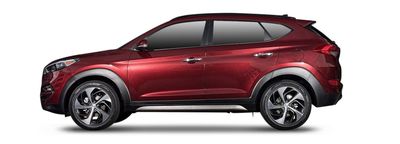
The third Hyundai Tucson generation brought a completely new engine range with state-of-the-art technology and significantly improved efficiency. Reliability reached new highs with typical mileages of 300,000 to 450,000 kilometers for the diesel engines. Major engine failures became a rarity, with only the 1.6-liter turbo engines showing occasional weaknesses in the timing chain. The absolute top engine was the 2.0 CRDi with 185 hp, which perfectly combined power, efficiency and reliability. This generation also introduced smaller turbocharged engines for the first time, which offered high performance despite their smaller displacement.
Hyundai Tucson gasoline engines: Generation III (2015-2021)
The Hyundai Tucson petrol engine range included the 1.6-liter naturally aspirated engine with 97 kW (132 hp), the 1.6-liter turbo with 130 kW (177 hp) and the 2.0-liter naturally aspirated engine with 122 kW (166 hp). The Hyundai Tucson 1.6 naturally aspirated engine proved to be very reliable, but weak-chested for the vehicle weight. The Hyundai Tucson 1.6 Turbo offered significantly better driving performance, but had problems with the timing chain and occasional turbocharger damage. The Hyundai Tucson 2.0 naturally aspirated engine was a good compromise, but was less economical than the turbo version. All engines had modern engine management systems and were combined with six-speed manual or six-speed automatic transmissions.
Hyundai Tucson diesel engines: Generation III (2015-2021)
The Hyundai Tucson 1.7 CRDi with 85 kW (115 PS) and 104 kW (141 PS) as well as the 2.0 CRDi with 136 kW (185 PS) made up the diesel range. The Hyundai Tucson 1.7 CRDi developed into the most economical engine in the range with a consumption of just 4.7-5.3 liters per 100 km, but was less suitable for towing a trailer. The Hyundai Tucson 2.0 CRDi with 185 hp offered excellent driving performance and high reliability, with only occasional problems with the EGR valve. All diesel engines complied with the Euro 6 standard and had SCR catalytic converters.
| Hyundai Tucson engine | Power output | Fuel consumption | Typical weaknesses | Rating |
|---|---|---|---|---|
| 1.6 naturally aspirated engine | 132 HP | 7.3-8.1 l/100km | Weak-chested | Average |
| 1.6 Turbo | 177 HP | 6.8-7.5 l/100km | Timing chain, turbocharger | Moderate |
| 2.0 naturally aspirated engine | 166 HP | 7.9-8.6 l/100km | High fuel consumption | Good |
| 1.7 CRDi | 115-141 HP | 4.7-5.3 l/100km | Weak when towing a trailer | Very good |
| 2.0 CRDi | 185 HP | 5.4-6.1 l/100km | EGR valve | Very good |
Hyundai Tucson Generation IV (2021-today)

The current Hyundai Tucson generation represents the technological pinnacle of the series with complete electrification of all drive systems. All petrol engines are now equipped with mild hybrid technology, and there are also powerful plug-in hybrids with an electric range of over 60 kilometers. As the generation has only been available since 2021, there is no long-term experience yet, but the initial tests show promising approaches. The top-of-the-range engine is the 1.6 T-GDI plug-in hybrid with 265 hp system output, which combines sporty driving performance with high efficiency. The mild hybrid technology promises a service life of over 350,000 kilometers, as the electric support relieves the combustion engine.
Hyundai Tucson mild hybrid petrol engine: Generation IV (2021-today)
The Hyundai Tucson engine range is based on two 1.6-liter turbo engines with 110 kW (150 hp) and 132 kW (180 hp), both with 48-volt mild hybrid technology. The Hyundai Tucson 1.6 T-GDI with 150 hp is considered to be particularly successful and is developing into the most balanced engine of this generation - it offers smooth power delivery and has so far been free of major series production problems. The more powerful 180 hp engine offers more power, but is already showing the first signs of problems with the timing chain at high mileages.
Hyundai Tucson plug-in hybrids: Generation IV (2021-today)
The Hyundai Tucson plug-in hybrid variants offer system outputs of 195 kW (265 PS) with an electric range of up to 62 km. These Hyundai Tucson engines combine the 1.6 T-GDI with a 66.9 kW electric motor and a 13.8 kWh battery. The Hyundai Tucson PHEV has shown good reliability so far, but is technically complex and requires specialized maintenance.
Hyundai Tucson diesel engines: Generation IV (2021-today)
A single Hyundai Tucson 1.6 CRDi with 85 kW (115 PS) and 48-volt mild hybrid system is available. This engine continues the tradition of economical Hyundai Tucson diesels, offering fuel consumption of just 4.9-5.4 liters per 100 km. Reliability appears to be at the same high level as the previous generation.
| Hyundai Tucson engine | Power output | Fuel consumption | Typical weaknesses | Rating |
|---|---|---|---|---|
| 1.6 T-GDI MHEV | 150 HP | 6.3-6.9 l/100km | No series problems so far | Very good |
| 1.6 T-GDI MHEV | 180 HP | 6.7-7.3 l/100km | Timing chain at high mileage | Good |
| 1.6 CRDi MHEV | 115 HP | 4.9-5.4 l/100km | Robust, proven | Very good |
| 1.6 T-GDI PHEV | 265 HP | 1.6 l/100km + electricity | Complex but efficient | Good |

Conclusion: The best Hyundai Tucson engines of all generations
The development of Hyundai Tucson engines shows a steady improvement in reliability and efficiency. While the early generations still struggled with classic problems, the modern mild-hybrid drives have proven to be very promising. The diesel engines remained the most reliable powertrains across all generations, while the gasoline engines only reached full maturity in the fourth generation.
- Best Hyundai Tucson gasoline engine:
The Hyundai Tucson 1.6 T-GDI MHEV (150 PS, Generation IV) combines modern mild-hybrid technology with high efficiency and excellent reliability to date.
- Best Hyundai Tucson diesel engine:
The Hyundai Tucson 2.0 CRDi (185 hp, Generation III) offers the best combination of performance, reliability and economy across all generations.
- Best Hyundai Tucson hybrid engine:
The Hyundai Tucson 1.6 T-GDI PHEV (265 hp, Generation IV) with its high electric range of 62 km and low fuel consumption.
For maintenance and spare parts for all Hyundai Tucson generations, AUTODOC offers a comprehensive range of original and quality spare parts with fast delivery.
TOP Products on the topic: