Tow Bar Guide: Everything You Need to Know About Towing in the UK
A tow bar is a device attached to your vehicle's chassis that allows you to pull trailers, caravans, or other loads safely. It connects to the trailer via either a ball mount or coupling system and transfers the towing load from your car's frame. Whether you need one for holiday caravans, work trailers, bike racks, or horse boxes, getting the right tow bar fitted properly is both a legal requirement and safety necessity.
With over 550,000 touring caravans registered in the UK and approximately 25% of vehicles across Europe fitted with tow bars, knowing your options matters. You must have the correct combination of vehicle and trailer, with proper loading applied horizontally and vertically on the tow ball. This guide covers the types available, tow bar fitting cost, legal requirements, and how to select the right one for your vehicle and needs.
Types of tow bars available in the UK
Choosing the right tow hitch is essential for safe towing. Different types of trailers may require different types of hitches, and the type you select depends on how often you tow and your aesthetic preferences.
Fixed (permanent) tow bars

Fixed tow bars are permanently mounted devices built directly onto your vehicle's rear chassis. They're the most economical option, with parts costing around £30–£100, making the total professional installation around £399–£800.
These systems are ideal for regular towing and offer excellent durability. The drawback is that they remain visible at all times, which some drivers find unappealing. If you're towing frequently for work or regularly taking your caravan away, a fixed towbar makes practical sense.
For more details on different designs, check our guide on tow hitch types.
Detachable tow bars

Detachable systems offer flexibility for occasional towers. Parts range from £60–£150 with complete installation typically costing £500–£1,000 in total.
There are two main variations:
Swan-neck detachable towbars feature an extended neck fitting that detaches from the tow bracket. The ISO standard tow ball used across most of the world is 50mm in diameter, conforming to BS ISO 1103:2007.
Flange-fitting detachable towbars use a flange plate system. These are often considered the most versatile option, allowing you to remove the visible towing element when not in use.
Around 25% of vehicles across Europe have tow balls fitted, with distinct regional variations. In Sweden, just over 50% of cars (around 2.2 million of 4.3 million vehicles) have tow balls installed.
Retractable (Swivel) tow bars
Premium retractable systems hide under your bumper when not in use. Parts typically cost £80–£200, bringing the total cost of a professional installation up to £600–£1,200.
They offer the cleanest appearance and are increasingly popular on modern vehicles where aesthetics matter. You can click a button to deploy or retract the tow ball as needed.
Where to find quality tow bars
You can buy tow bars from AUTODOC's extensive catalogue, which includes leading manufacturers:
Historical context
Franz Knöbel of Westfalia-Werke invented the ball head-socket joint trailer hitch in 1932. Before this innovation, all trailers used only jaw or hook couplings with an eyelet for towing. Knöbel patented his invention on 14 March 1934, transforming the towing industry.
Understanding tow bar classifications
The most common type of tow hitch is a receiver hitch, which has a square tube attached to the vehicle's frame. The weight-carrying hitch, a.k.a. receiver hitch, bolts directly to the vehicle's frame and offers a greater towing capacity than a bumper-mounted hitch.
North American SAE classes
While UK vehicles follow different standards, US classifications can help when researching which products are suitable for your car:
| Class |
Capacity |
Applications |
| Class I |
Up to 2,000 lbs (910 kg) |
Light-duty towing |
| Class II |
Up to 3,500 lbs (1,600 kg) |
Light trailers, bike racks |
| Class III |
Up to 8,000 lbs (3,630 kg) |
Campers, boats |
| Class IV |
Up to 10,000 lbs (4,540 kg) |
Larger loads |
| Class V |
Up to 17,000 lbs (7,700 kg) |
Heavy equipment |
UK and EU standards
UK vehicles must comply with EU regulations. The UK follows EU Directive 94/20/EC, which was replaced by Regulation EU 2019/2144 in July 2022.
Vehicles first registered on or after 1 August 1998 must have type-approved tow bars. This means the vehicle manufacturer or aftermarket manufacturer must prove the tow bar meets safety standards through full rig-based fatigue testing.
If your car was first used before 1 August 1998, your tow bar does not need to be type-approved.
How tow hitches (bars) work
The hitch transfers the forces from the trailer, such as acceleration, braking, and turning, to the towing vehicle's chassis, suspension, and drivetrain. A ball mount, which has a ball on the end, is inserted into the receiver tube and secured with a hitch pin.
For more information on terminology, read about tow hitch functions.
How much does a tow bar fitting cost in 2025?
Having your new towbar fitted is simple and secure when installed by experienced, trained technicians. A professional installation ensures compatibility with your vehicle's systems and helps maintain your warranty.
Complete installation costs
| Tow bar type |
Total cost (including installation) |
| Fixed tow bars |
£399–£800 |
| Detachable systems |
£500–£1,000 |
| Retractable systems |
£600–£1,200 |
Electrical systems
Electrical hook-ups are essential for connecting trailers to the towing vehicle electrics. There are usually two types of connectors:
7-pin connectors (£50–£100)
- Standard for basic trailer lighting
- Handles indicators, brake lights, and rear lights
- Suitable for simple trailers and bike racks
13-pin connectors (£80–£150)
- Essential for caravans
- Provides power for charging, reversing cameras, and interior lighting
- Required for most modern towing applications
Labour and installation
A basic fitting on straightforward vehicles costs around £200–£400. This includes mounting the tow bar to the rear crash beam and connecting electrics.
Installations requiring bumper removal or extensive electrical integration cost £400–£800. Premium brands often need specialised programming to work with parking sensors, stability control, and other safety systems.
Mobile installation services add approximately £35 to standard prices but offer convenience. You can arrange your fitting appointment at a date, time, and location convenient to you, and your towbar is professionally installed and fully tested while you go about your day.
For comprehensive pricing details, visit our tow bar fitting cost page.
UK towing laws and legal requirements
Following UK towing laws is not optional. Breaking regulations can result in fines up to £1,000, six penalty points, and potential driving bans.
Driving licence requirements
The rules changed as of 16 December 2021:
If you passed your test before 1 January 1997:
- You can usually drive a vehicle and trailer with a combined weight of up to 8,250 kg Maximum Authorised Mass (MAM)
- You're also allowed to drive a minibus with a trailer over 750 kg MAM
- These are "grandfather rights"
If you passed your test from 1 January 1997 onwards:
- You can now tow trailers up to 3,500 kg MAM without an additional test
- This change was automatic – your DVLA records were updated
- For anything heavier, you need to pass a B+E test
Essential equipment requirements
Type approval: tow bars must be EC type-approved for vehicles registered after 1 August 1998. The vehicle manufacturer establishes mounting points, and tow bracket manufacturers must prove efficacy through testing.
Breakaway cable: legally required on all braked trailers and caravans. This ensures the trailer stops safely if it detaches from your vehicle. For unbraked trailers, a secondary coupling or chain is required to prevent detachment.
Number plates: the trailer or caravan must display a number plate that matches the towing vehicle. You can be fined for non-compliance.
Lighting: trailers must have working lights, indicators, and reflectors. If your trailer exceeds 750 kg or 6 metres in length, reverse lights are mandatory.
Braking systems: any trailer weighing more than 750 kg when loaded must have its own braking system. Some smaller trailers also have brakes, but these are optional. Our guide to hitching an unbraked trailer in the UK provides essential safety measures.
Speed limits when towing
| Road type |
Speed limit |
| Single carriageway |
50 mph |
| Dual carriageway |
60 mph |
| Motorway |
60 mph |
You cannot use the outside lane of three-lane motorways while towing, unless other lanes are closed.
Weight and loading rules
The 85% rule: caravan experts say that your trailer shouldn't exceed 85% of your vehicle's kerb weight. Sticking to this rule maintains proper acceleration, braking, and turning capabilities.
Maximum noseweight: every vehicle has a maximum noseweight (downward force on the tow ball). You need to find this out before hitching the trailer.This information is typically found in your owner's manual or on the VIN plate.
Towing mirrors: fit suitable towing mirrors if your trailer or caravan is wider than the rear of your car. You can be fined up to £1,000 for towing without proper mirrors.
Choosing the right tow bar for your vehicle
Check your vehicle's towing capacity
Before you order any equipment, you must verify your vehicle can legally tow. Don't presume that because your car looks capable, it is.
Find your vehicle's VIN plate (usually on the driver's door pillar, passenger door pillar, or engine bay). Look for the Gross Train Weight (GTW) value.
Calculate: GTW minus the Gross Vehicle Weight equals the maximum towing weight.
Some vehicles have zero towing capacity. This means that the vehicle manufacturer has not officially approved its towing capability. If you're unsure whether your car has a tow bar installed, check before purchasing.
Vehicle-specific options
AUTODOC offers compatible tow bars for most popular UK vehicles:
Electric vehicle considerations
2024 saw record EV sales in the UK, representing a 19.6% market share with 381,970 battery electric vehicles sold. Many modern EVs can be used for towing, but the range subsequently drops by 30–50% when carrying larger loads.
Popular EV towing capacities:
- Tesla Model X: 2,300 kg (range reduction around 29%)
- BMW iX: 2,500 kg (loses up to 50% range at maximum capacity)
- Rivian R1T: 4,990 kg (range roughly halves when fully loaded)
An EV tow bar installation usually costs more due to additional technology integration required.
Tow bar installation and maintenance
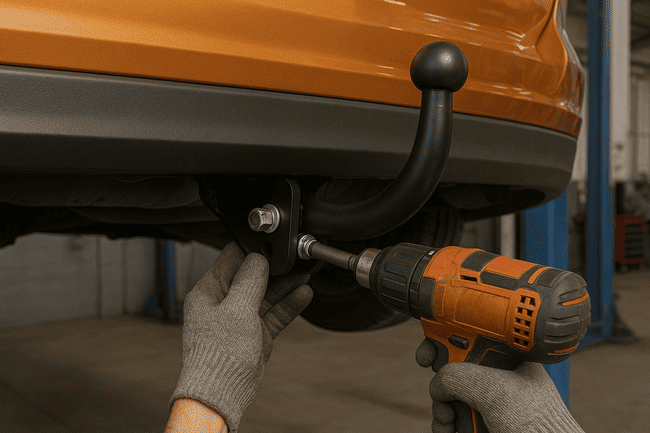
A professional trailer hitch installation typically takes 2-4 hours. The process includes:
- Mounting the towbar to the rear crash beam or chassis mounting points
- Electrical integration with vehicle systems
- Software coding for modern vehicles with CAN-bus systems
- Testing all functions
- Final safety checks
Many businesses offer mobile installation services. You can book an appointment at a time and location convenient to you, and technicians come to your home or workplace.
Maintenance requirements
Regular maintenance keeps your tow bar safe and functional:
Apply tow bar grease to:
- Tow ball surface (prevents wear and reduces noise)
- Coupling mechanism (ensures smooth operation)
- Moving parts on detachable systems
Inspect regularly:
- Mounting bolts for tightness
- Electrical connections for corrosion
- Ball mount for wear or damage
- Safety chains and breakaway cable
Clean regularly:
- Remove salt and debris buildup (especially in winter)
- Wash couplings after off-road use
- Keep electrical contacts clean
MOT and legal inspections
Trailers with over 1,020 kg unladen weight need annual MOT testing. Lighter trailers and caravans are MOT-exempt but must remain in a roadworthy condition.
Your tow bar itself is checked as part of your vehicle's MOT. Inspectors verify it's securely mounted and not damaged.
Special towing equipment and accessories
Adjustable height systems
Not all trailers sit at the same height. An adjustable height tow hitch allows you to match your trailer's coupling to your vehicle's tow coupling’s height.
A ball mount that can be adjusted ensures level towing. This prevents:
- Excessive trailer sway
- Uneven tyre wear
- Poor headlight aim
- Handling problems
Extensions and adapters
Sometimes you need extra clearance. A tow bar extension provides additional distance between your vehicle and trailer. This is particularly useful when towing twin-axle caravans or when you need clearance for bike racks.
Weight distribution systems
For heavier loads, weight distribution systems use spring bars to evenly distribute the trailer's weight across the tow vehicle's and trailer's axles. A weight-distributing hitch helps reduce:
- Trailer sway (also called fishtailing)
- Trailer hop that jerks the tow vehicle
- Stress on rear suspension
- Front axle lift
Most vehicle manufacturers only allow a maximum trailer capacity of 2,300 kg and 230 kg of tongue weight without using a weight-distributing hitch.
Heavy-duty hitch systems
Fifth-wheel hitch: A fifth-wheel hitch, which connects to a kingpin on the trailer, provides superior stability and control compared to a bumper-pull one and can handle heavy loads up to 30,000 lbs. These are popular for large recreational vehicles.
Gooseneck tow bars: Gooseneck bars are mounted directly in a pickup truck's bed, usually over the rear axle, and are designed for heavy-duty towing. They provide a tighter turning radius and enable the use of the entire truck bed when not towing.
Pintle hooks: used in agricultural, industry, and military applications. A pintle hook and lunette ring offer a more secure coupling on rough terrain compared to ball-type couplings.
Common towing mistakes to avoid
With caravans involved in approximately 11 road accidents per day in the UK, following proper procedures is critical.
Critical errors to avoid:
- Exceeding your vehicle's maximum towing capacity
- Improper weight distribution (too much tongue weight affects steering)
- Failing to notify your insurance company about towing
- Using non-type-approved equipment
- Neglecting to attach the breakaway cable
- Towing without proper mirrors when the trailer is wider than the vehicle
- Exceeding towing speed limits
- Poor load securing in trailers
- Ignoring the 85% guideline for stability
- Using universal electrical kits instead of vehicle-specific wiring
Conclusion
Proper tow bar selection and installation is essential for safe towing in the UK. Customer satisfaction is at the forefront of every sale when you choose quality equipment and a professional fitting.
To tow safely, you need to have the correct combination of vehicle and trailer, with proper loading applied both horizontally and vertically on the tow ball. Understanding your legal obligations, vehicle capacity, and equipment requirements protects you and other road users.
Whether you're towing for leisure or work, investing time in getting the setup right pays dividends in safety and reliability. The range of quality tow bars available has never been better, with options to buy online that suit every vehicle type and budget.
Visit AUTODOC to find compatible tow bars for your vehicle and book a professional installation. With years of experience and advice from industry experts, you'll find everything you need for safe, legal towing.


 29 October 2025 (updated)


