Table of Contents

 30 September 2025 (updated)
 Volvo V50 engines
The Volvo V50 was launched in 2003 as a compact estate car and quickly established itself as a practical alternative to its German premium competitors. Across a generation of vehicles, Volvo offered a diverse Volvo V50 engine range with both gasoline and diesel units. The technological development reflected Volvo's focus on safety and reliability, with the later engine variants in particular benefiting from continuous improvements.

Volvo V50 Generation I (2003-2012)
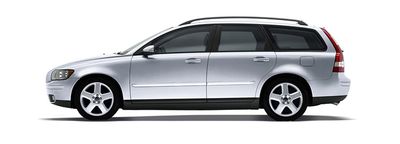
The first and only Volvo V50 generation was based on the Ford C1/P1 platform and shared it with the Ford Focus and Mazda3. This cooperation brought both advantages and disadvantages: while production costs could be reduced, some Ford components led to specific weaknesses. The Volvo V50 engines typically reached 250,000 to 350,000 kilometers with proper maintenance, whereby the diesel variants were significantly more durable than the petrol versions. Major repairs were usually due between 150,000 and 200,000 kilometers, especially for the turbo gasoline engines. The absolute top engine of this generation was the 2.0D with 136 hp, which optimally combined reliability, economy and sufficient power. Technical highlights were the advanced common-rail diesel engines and the later FlexiFuel petrol engines, while the early T5 engines struggled with turbocharger problems. In market comparison, the V50 positioned itself as a practical alternative to the BMW 3 Series Touring and Audi A4 Avant, but was never able to match their prestige.
Volvo V50 petrol engines: Generation I (2003-2012)
The Volvo V50 petrol engine range included various naturally aspirated engines and turbo units. It started with the 1.6-liter naturally aspirated engine with 100 hp, followed by the 1.8-liter with 125 hp. Both proved to be reliable but uninspiring. The 2.0-liter naturally aspirated engine with 145 hp offered more power, but also remained unremarkable. The highlight of the gasoline engines was the T5 with a displacement of 2.5 liters and turbocharging, which was offered in various power levels from 220 to 230 hp. This Volvo V50 T5 was considered one of the most characterful engines in the series, but suffered from typical turbocharger problems and increased oil consumption after higher mileages. From 2006, FlexiFuel variants (E85) were introduced, which could run on ethanol. The most problematic petrol engine was clearly the early T5 (2003-2005), which frequently exhibited turbocharger damage and problems with the engine control unit.
Volvo V50 diesel engines: Generation I (2003-2012)
The Volvo V50 diesels were dominated by the 2.0-liter common-rail engine in various versions. With 136 hp, the 2.0D was the most popular variant and developed into the most reliable engine of the entire series. Later, a weaker version with 115 hp was added, which was particularly economical. For sporty demands, there was the D3 with 150 hp and the D4 with 177 hp, both with improved injection technology and turbocharging. All Volvo V50 diesel engines had particulate filters and met at least the Euro 4 standard. The D5 with 180 hp was the most powerful diesel, but was used less frequently. These engines were characterized by low consumption (4.5-6.0 l/100km), very smooth running and excellent long-term quality. Problems occurred mainly due to neglected maintenance, especially with the particulate filter and the injection system.
| Volvo V50 engine | Power output | Fuel consumption | Typical weaknesses | Rating |
|---|---|---|---|---|
| 1.6 naturally aspirated engine | 100 HP | 7.2-8.1 l/100km | Little power, sluggish | Average |
| 1.8 naturally aspirated engine | 125 HP | 7.5-8.3 l/100km | Moderate performance | Average |
| 2.0 naturally aspirated engine | 145 HP | 7.8-8.7 l/100km | High fuel consumption | Average |
| T5 Turbo | 220-230 HP | 9.1-10.2 l/100km | Turbocharger damage, oil consumption | Moderate |
| 2,0D | 115-136 HP | 4.5-5.8 l/100km | Very robust and economical | Very good |
| D3 | 150 HP | 5.2-6.0 l/100km | Occasional injection problems | Good |
| D4/D5 | 177-180 HP | 5.8-6.5 l/100km | Complex, but reliable | Good |

Conclusion: The best Volvo V50 engines of all generations
The Volvo V50 engine range showed clear differences between gasoline and diesel units, with the diesels being consistently convincing. While the naturally aspirated petrol engines were reliable but not very exciting, the sporty T5 struggled with typical turbocharger problems. The diesel engines, on the other hand, set standards in terms of reliability and economy, which made the V50 particularly attractive for frequent drivers.
- Best Volvo V50 gasoline engine:
The 2.0-liter naturally aspirated engine with 145 hp offered the best combination of reliability and sufficient power, even if it was not particularly economical.
- Best Volvo V50 diesel engine:
The 2.0D with 136 hp was the absolute highlight of the range - reliable, economical and with enough power for everyday driving.
- Best Volvo V50 hybrid engine:
Hybrid powertrains were not available on the V50, as development ended before Volvo's hybrid era.
For maintenance and spare parts for the Volvo V50, AUTODOC offers a comprehensive range of original and quality spare parts with fast delivery and expert advice.
TOP Products on the topic: