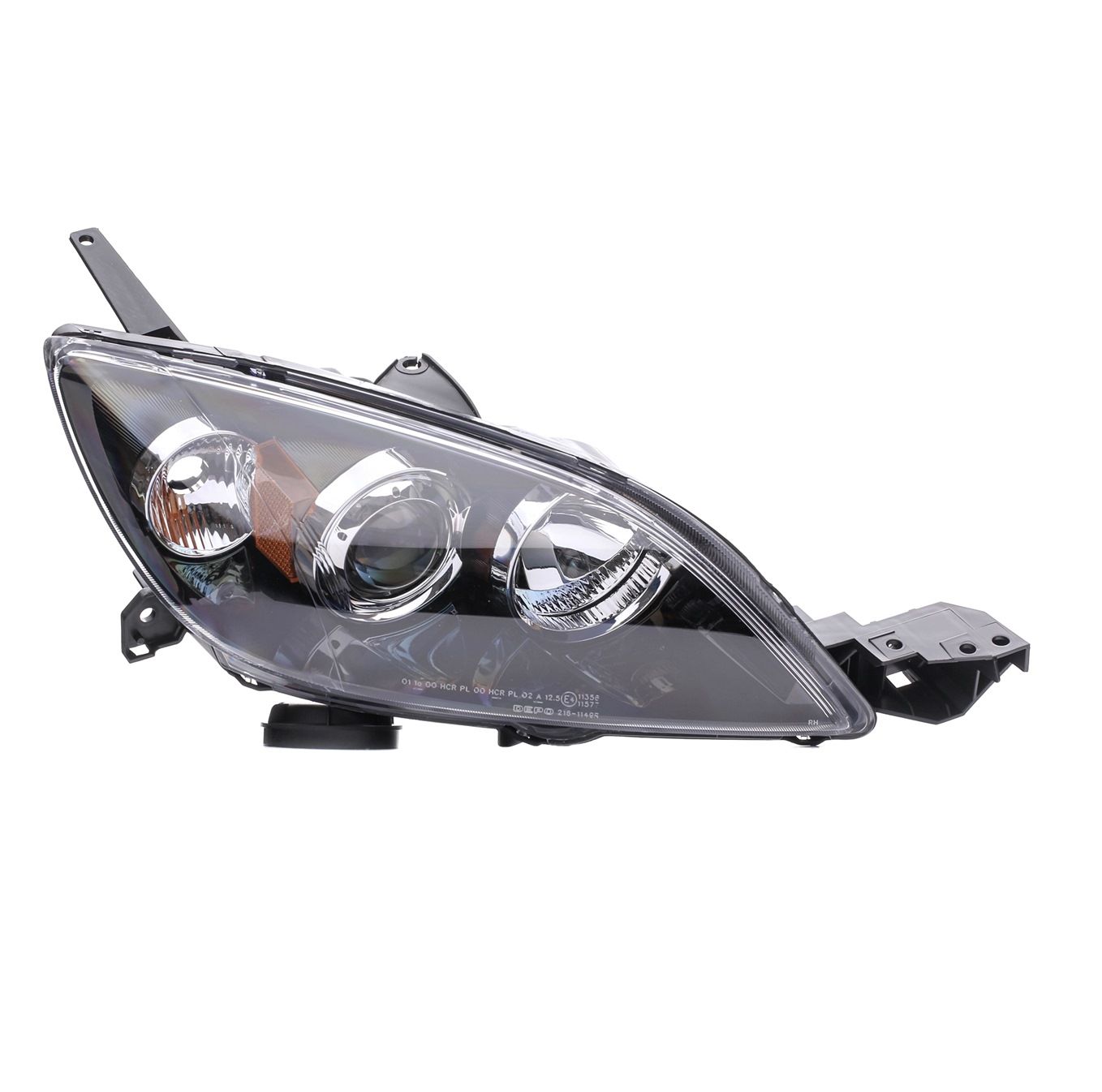
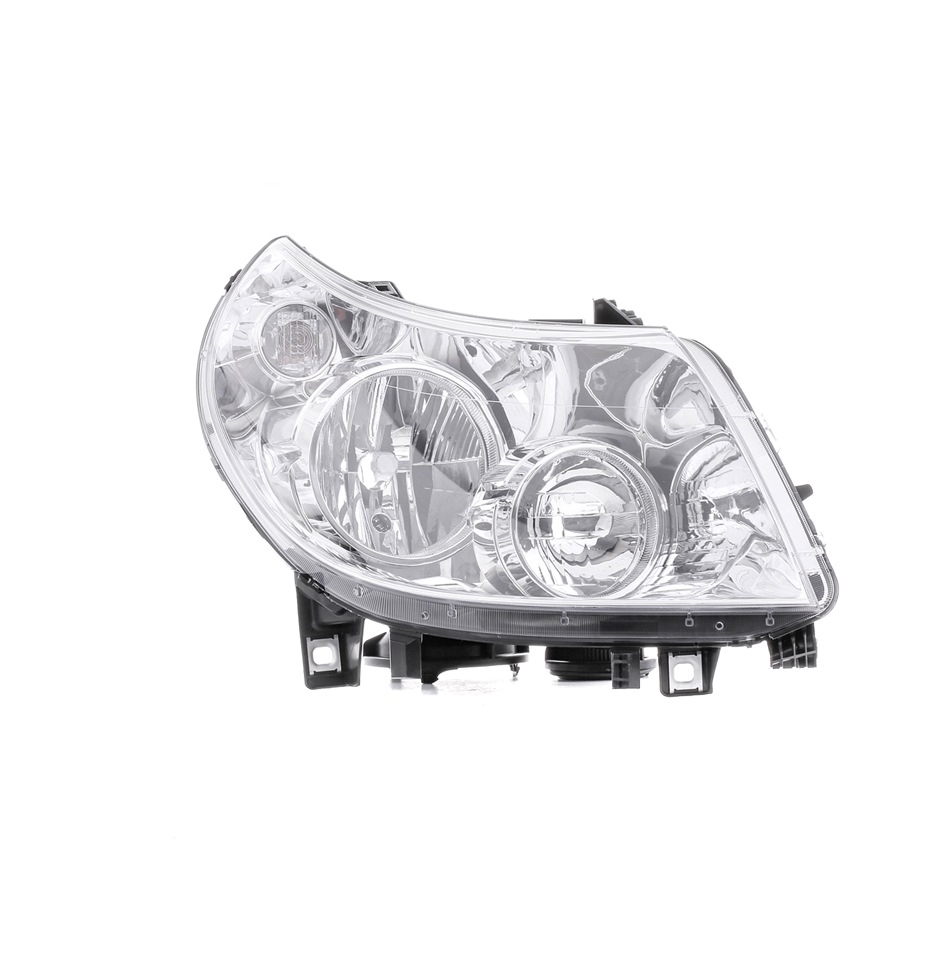
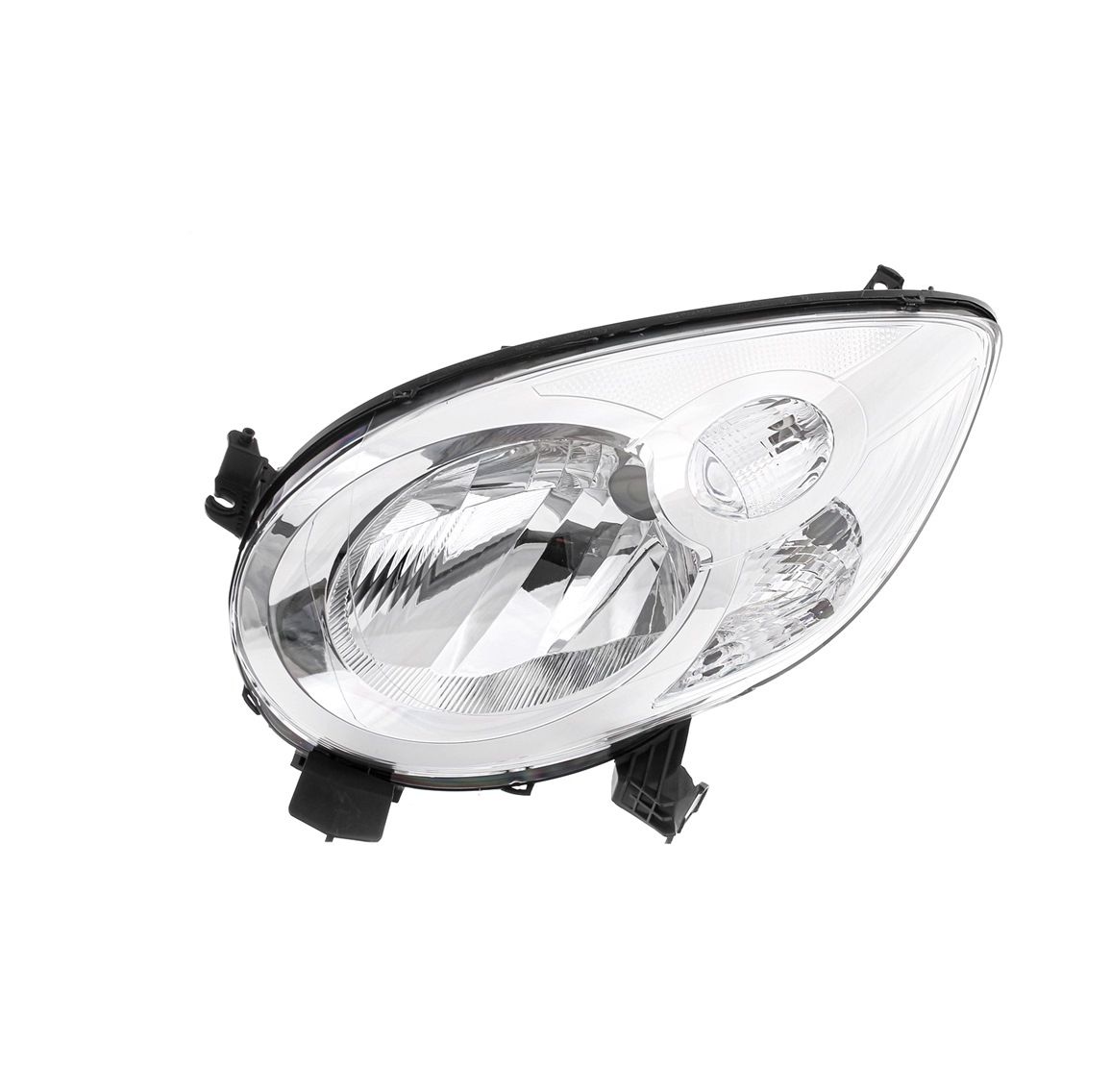
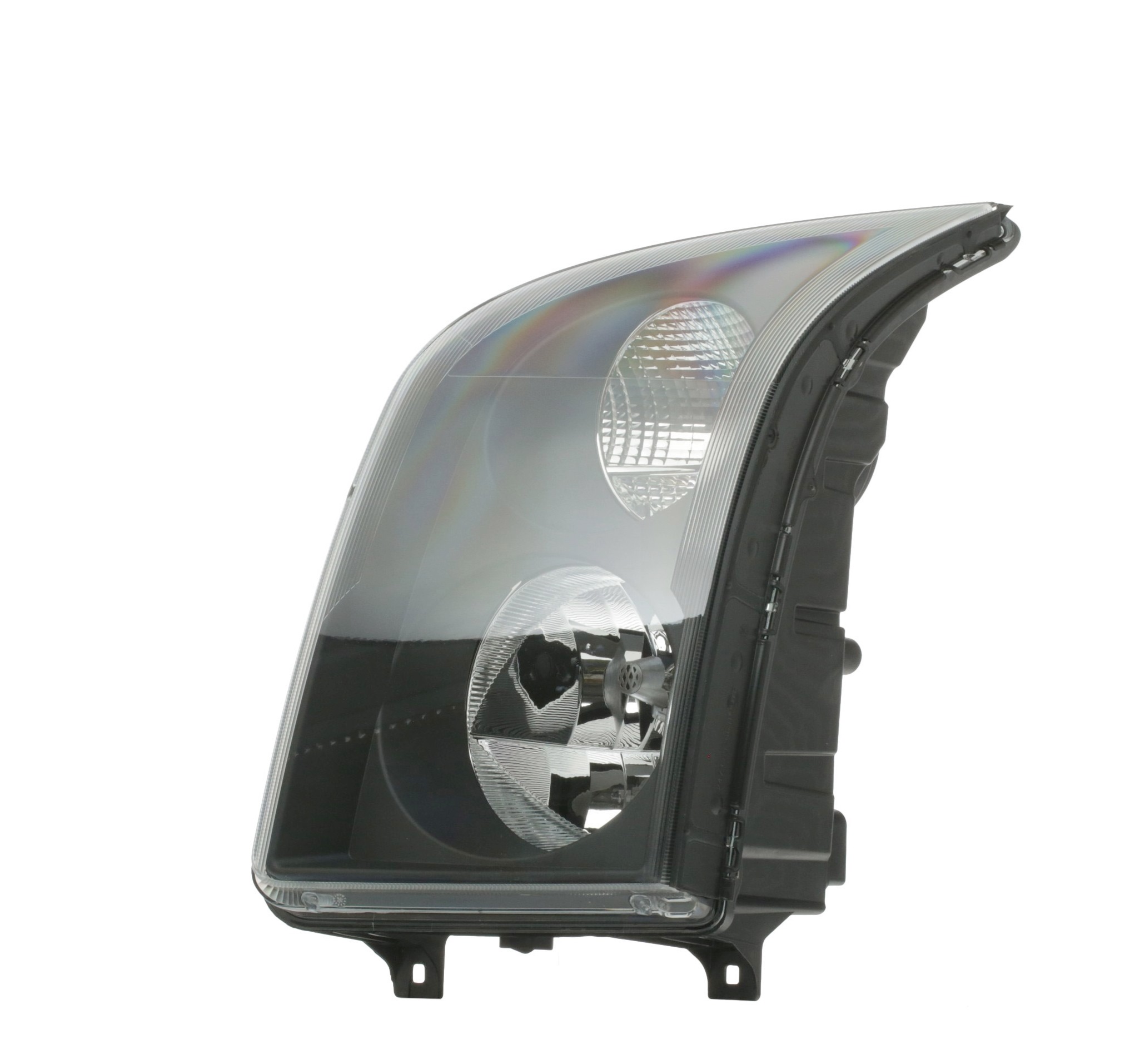
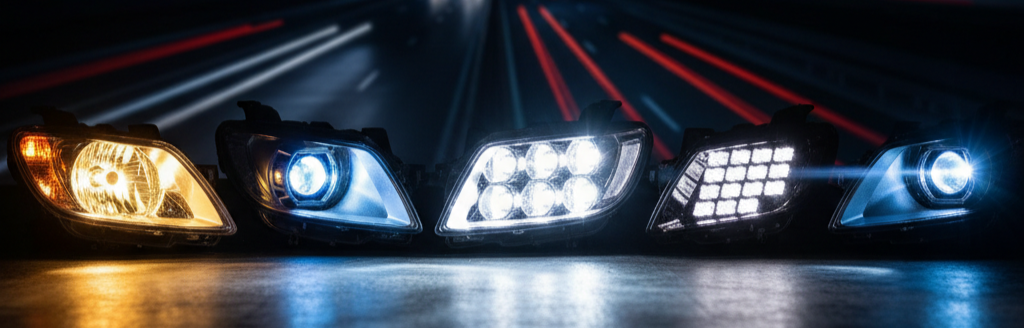
Three light sources for vehicle headlights dominate the market: Halogen, HID/xenon and LED. The technologies differ significantly in terms of light output, energy consumption, and service life. Halogen usually only lasts a few hundred hours, xenon around two to three thousand, and LED several thousand hours in practice. Choosing the right lighting not only improves visibility at night, but also actively increases safety depending on the driving situation and weather.
Comparison table: Headlight types at a glance
Headlight type
Special feature
Price range
Installation costs
Service life
Halogen
Classic basic equipment for older models
€5–50
€30–80
500–1,000 hours
Xenon/Bixenon
High brightness
€60–200
€50–250
approx. 2,000 hours
LED
Modern efficiency with a long service life
€100–300
€150–400
up to max. 30,000 hours
Matrix LED
Adaptive LED headlights with segmented high beam
€300–800
€400–900
up to max. 30,000 hours
Laser
High beam boost with very long range, only used in a few premium models
€1,000+
€800–1,500
no reliable data on hours in practice
Note on the valuation methodology: This comparison is based on the evaluation of real customer reviews, technical product features, and current market prices. We have not carried out our own product tests, but have summarised the experiences of drivers and the technical specifications of the manufacturers.
Tip from AUTODOC experts: Before replacing the headlights, be sure to check that they are compatible with your vehicle. Not every car can be easily converted to LED or xenon – the electronics must support the new technology.
Halogen headlights: proven lighting technology
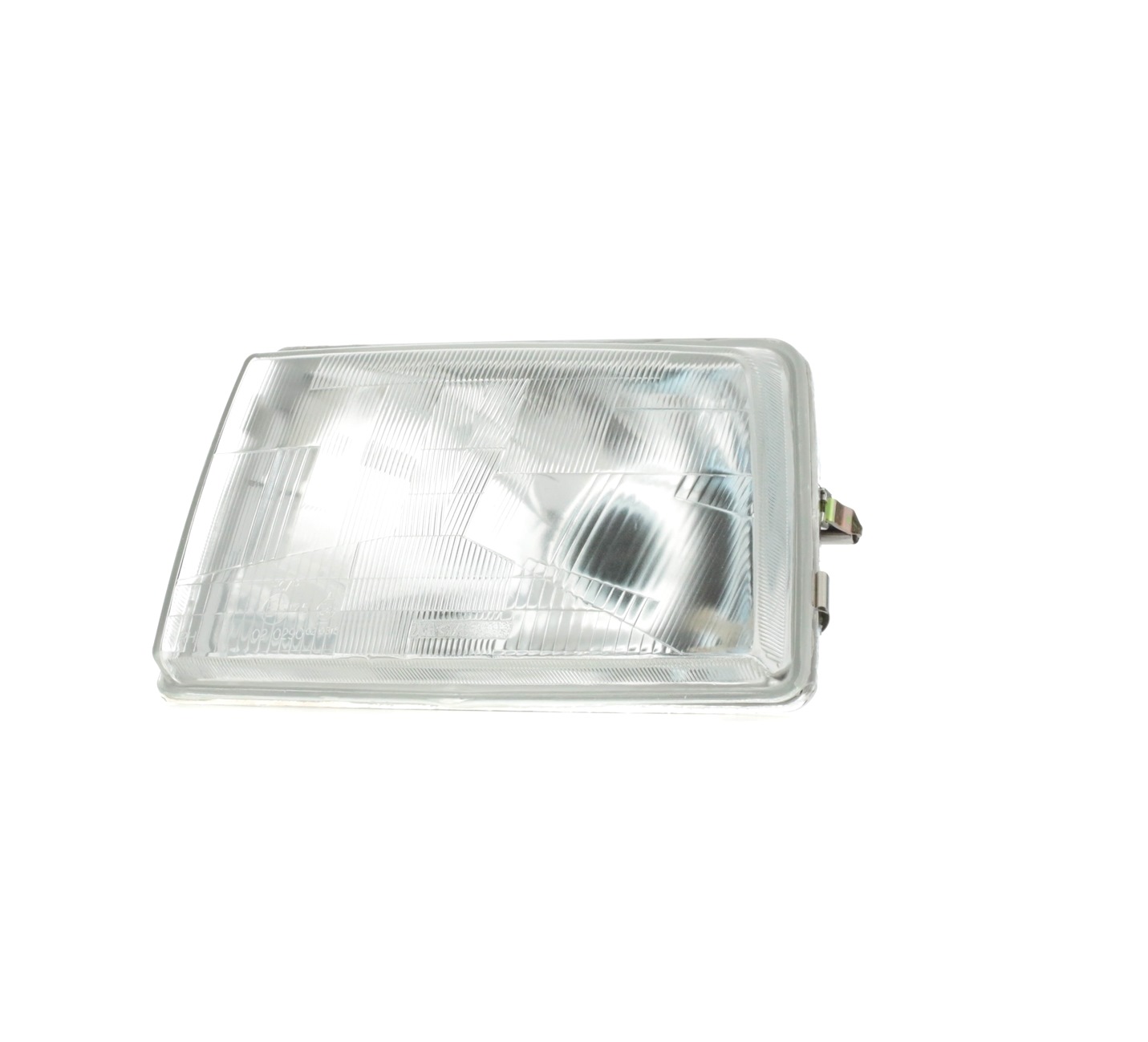
Halogen floodlights use a tungsten filament in a quartz glass bulb filled with halogen gas (e.g. bromine or iodine). The halogen circuit prevents the bulb from blackening and allows higher operating temperatures. This increases the luminous efficacy and the service life is usually comparable to or slightly longer than that of classic incandescent lamps. The light appears warm white with a typical colour temperature of approx. 3,200–3,400 K. The simple, robust design facilitates repair and replacement.
Halogen headlights were standard in many vehicles for decades and are still widely used in basic models. The heat development during operation is relatively high, which has both advantages and disadvantages. One advantage is that headlights are quickly cleared of snow and ice in wintery conditions. They provide sufficient visibility for everyday traffic, but lag behind xenon/LED in terms of range and homogeneity.
This type of headlamp is particularly suitable for owners of older vehicles, price-conscious novice drivers and occasional drivers with little night-time driving. Halogen was usually standard in small and compact cars until the late 2010s; many current basic versions continue to use it, while higher trim levels increasingly offer LED as standard.
Advantages of halogen headlights
Very low purchase costs for replacement bulbs
Simple replacement possible without a specialist
Wide availability for almost all car brands
No additional electronics required
High heat development thaws snow and ice from the headlamp in winter
Disadvantages of halogen headlamp systems
Depending on type, service life usually only approx. 400–1,000 operating hours
Higher energy consumption than modern alternatives
Lower brightness/range
Costs and installation of halogen bulbs
Halogen bulbs cost between €15 and €50 per pair, and installation in a garage costs between €30 and €80, depending on accessibility and the vehicle model. Thanks to the simple design, many models can be changed by the user.
Typical models (depending on trim level and year of manufacture): VW Golf, Ford Fiesta, Opel Corsa, Renault Clio, Peugeot 208, Škoda Fabia, Seat Ibiza, and Toyota Yaris. Owners benefit from low-cost maintenance and sufficient light output for everyday use.
Xenon headlights: powerful light for better visibility
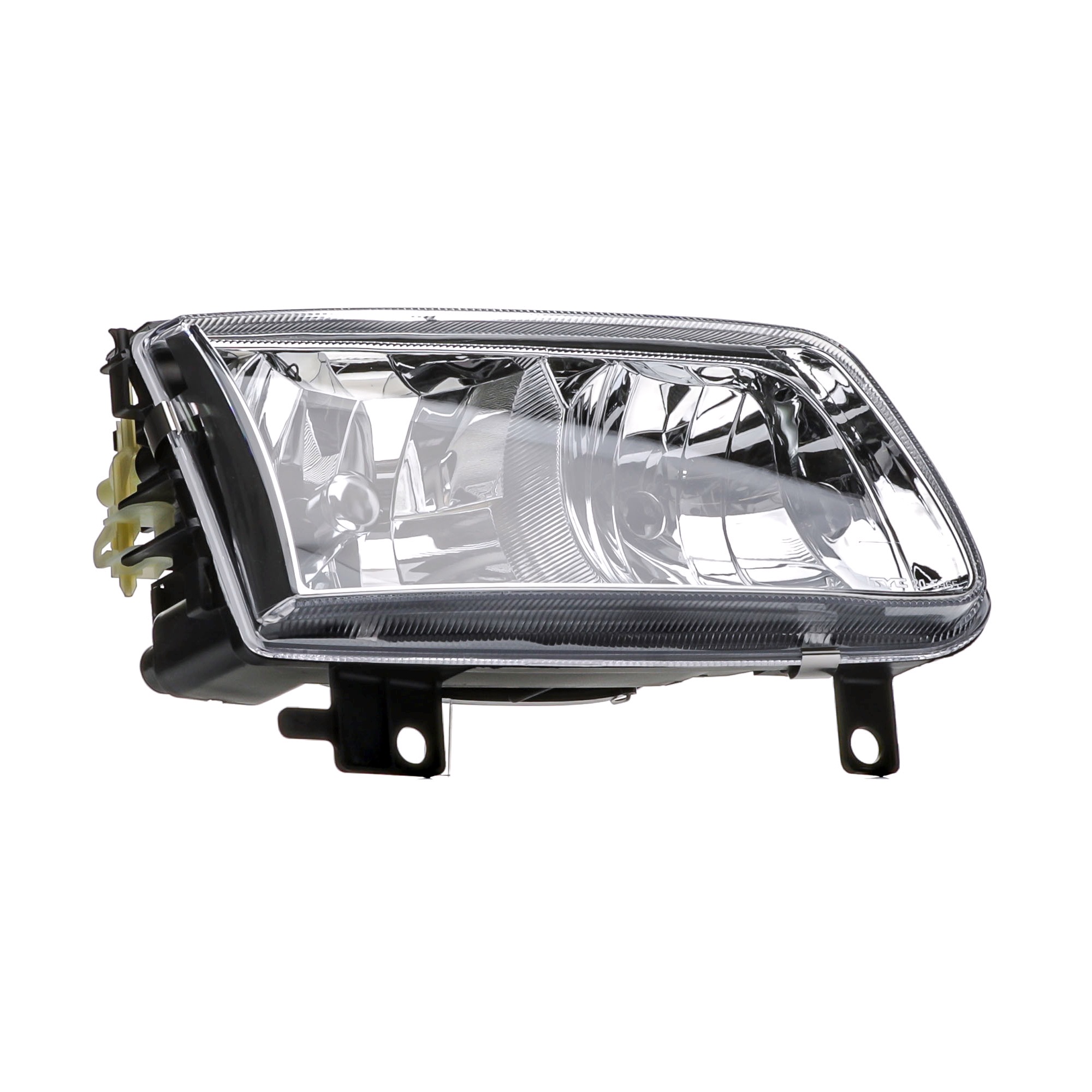
Xenon is a colourless noble gas with extremely low reactivity. Xenon gas discharge lamp technology was developed by Philips and Osram and was a significant advance in lighting technology. Unlike conventional incandescent lamps, xenon lamps do not require a sensitive filament. Instead, the light is produced by an electric arc that is generated between two electrodes in a tube filled with xenon. The addition of metal salts further increases the light output, resulting in a particularly intense luminosity.
Xenon lighting is ideal for medium-size vehicles, frequent travellers and commuters, as well as anyone who frequently drives on unlit country roads. The technology is used in upmarket compact cars and mid-range saloons.
Advantages of xenon headlights
Significantly better illumination of the road than halogen
Longer service life
Lower power consumption with more light
Colour temperature similar to daylight
Proven high-volume technology with wide distribution
Disadvantages of xenon car headlights
Higher costs for replacement bulbs
More complex installation due to high-voltage ignition/ballast unit
Danger of glare with incorrect setting
Costs and installation of xenon bulbs
Xenon bulbs cost between €80 and €200 to purchase and an additional €100 to €250 to install professionally, although this depends greatly on the vehicle model and the garage. Headlight levelling and headlight cleaning systems are required by law.
Vehicle models with xenon equipment
Many vehicles today are equipped with xenon headlights. Bright lighting from gas discharge lamps is used particularly in upper mid-range and luxury class vehicles – such as those from Mercedes-Benz, BMW, or Audi. The first models with this technology included the BMW 7 Series (1991) and the Audi A8 (1994).
LED headlights: modern efficiency meets durability
LED technology, which is widely used today, goes one step further than xenon. With a colour temperature of around 5,500 to 6,000 Kelvin, LED lights produce an illumination that comes very close to natural daylight. In comparison, xenon headlights appear significantly warmer and less intense.
LED headlights that comply with regulations not only illuminate the road more brightly, but also more broadly and further ahead. For drivers, this means greater safety and comfort: The eye-friendly light noticeably reduces fatigue when driving at night and in poor weather conditions. LED light also reduces glare in fog or rain, which further improves visibility.
The compact design of the light-emitting diodes enables flexible designs and flat headlight shapes, which is a feature of modern vehicle fronts. LED systems switch on without delay and reach their full brightness immediately, whereas xenon ones need a few seconds to warm up. The service life of up to 30,000 operating hours means that the lamps often last the entire service life of the vehicle. According to experts at AUTODOC, LED headlights are the best overall solution for new vehicles.
LED technology is recommended for new vehicles built in 2015 or later, for environmentally conscious drivers who value energy efficiency, and for modern vehicles with appropriate electronics. Premium compact cars and executive cars often have LED lighting as standard.
Advantages of LED headlights
Extremely long service life reduces maintenance costs
Very low power consumption saves the battery
Immediate full brightness without delay
Flexible design options for vehicle designers
Cool, daylight-like light for optimum visibility
Disadvantages of LED headlights
Higher purchase costs than halogen or xenon
Complex electronics can make repairs more expensive
Retrofitting is often difficult with older vehicles
Costs and installation of LED headlights
LED headlight modules cost between €100 and €300, with professional installation costing an additional €150–400. The higher costs are offset by the long service life and low energy consumption. Please note that all prices are dependent on the vehicle model and the garage carrying out installation.
Vehicle models with LED systems
Today, LED systems are fitted as standard in numerous vehicles. This is particularly evident in premium models such as the Tesla Model S, which has had adaptive full LED headlights since 2016 and has even been equipped with matrix lighting technology since 2022. The Audi A8 also relies on HD matrix LED headlights, whose 25 individually controllable LEDs per side enable precise illumination of the road. Full LED systems are used in the BMW 7 Series, which are optionally supplemented by laser high beam modules that allow ranges of over 600 metres. The Mercedes-Benz S-Class also uses the MULTIBEAM LED system as standard, which integrates 84 individually controllable light sources per headlamp for a glare-free, adaptive high beam.
Matrix LED headlights: intelligent lighting systems for maximum safety
Matrix LED headlights consist of several individually controllable light-emitting diodes arranged in a matrix. A control unit continuously analyses the traffic situation using a front camera and automatically adjusts the light distribution. Individual LED segments are selectively dimmed or switched off so as not to dazzle oncoming vehicles or vehicles in front, while the rest of the road remains optimally illuminated. This adaptive high beam function works fully automatically and significantly increases safety when driving at night.
Some systems have more than 50 individual LEDs per headlight, which enables precise light control. The technology also recognises traffic signs and can illuminate them in a targeted manner. On bends, the light beam swivels and illuminates the road ahead. LED matrix headlights (premium models) achieve a range of up to 600 metres with an active high beam. The quality of light surpasses conventional LED systems thanks to its flexible adaptability to any driving situation.
Matrix LED systems are particularly suitable for people who frequently travel on motorways and country roads, as well as for safety-conscious drivers with high lighting requirements. Luxury class vehicles and premium SUVs in particular are often equipped with this technology.
Advantages of matrix LED headlights
Optimum illumination thanks to adaptive light distribution
Increased safety through early detection of obstacles
Cornering light and dynamic adaptation to the driving situation
Long service life
Disadvantages of matrix LED headlights
High cost
Complex technology requires a specialist in case of defects
Danger of glare due to high brightness
Costs and installation of laser headlights
Matrix LED units cost €300–800 per headlight, with installation costing €400–900. The investment is worthwhile for anyone who is often out and about in the dark. Please note that all prices are dependent on the vehicle model and the garage carrying out installation.
Which cars have LED matrix lights?
Matrix LED headlights used to be the preserve of luxury class vehicles and premium brands such as Audi, BMW, and Mercedes. Nowadays, however, innovative lighting technology has also become increasingly established in medium-size and compact cars. Many manufacturers now offer them for an extra charge or in higher trim levels. Audi models such as the A3, A4, Q3, and Q5 are available with matrix LED headlights. BMW also uses the technology in model series such as the 1 Series, 3 Series, X1, and X3. Hyundai offers it in the Tucson, while Mercedes has equipped the A-Class, C-Class, and GLA with it. Vauxhall uses matrix LED lights in the Astra and Insignia, among others, while Skoda uses it in models such as the Octavia and Superb. Volkswagen has also integrated the technology into popular vehicles such as the Golf, Passat, and Tiguan.
Laser headlights: Cutting-edge technology for the highest demands
Laser spotlights use blue laser diodes whose light hits a phosphor-containing converter where it is converted into an intense white light. Manufacturer information shows that by using these laser modules, for example from ams OSRAM, the high beam range can be almost doubled compared to conventional LED headlights, to around 600 metres. One example is the Audi R8 LMX series model, in which the laser spot unit supplements the LED high beam from around 60 km/h and achieves a colour temperature of approx. 5,500 Kelvin. The technology is currently mainly available in high-performance and luxury vehicles.
Advantages of laser car headlights
High range
Highest energy efficiency of all headlight types
Best visibility at high speeds
Disadvantages of laser headlights
Very high costs limit distribution
Only available in a few premium models
Repairs require specialist garages
Costs and installation of laser headlights
Laser headlights are among the most expensive lighting systems on the market. According to industry figures, the cost per unit is several thousand euros, depending on the manufacturer and vehicle model. Added to this are high installation and calibration costs, as the systems require precise adjustment and special control units. Due to this complexity, laser headlights are currently aimed exclusively at the premium segment.
Availability in vehicle models
Laser light systems are currently only available in a few luxury and sports car models. These include the BMW 7 Series (G11), the BMW i8, the Audi R8 LMX (the first production model with laser high beam), and the Audi A8 (D5).
Expert opinion from AUTODOC: When retrofitting modern lighting systems, you should bear in mind that additional components such as automatic headlamp levelling, headlamp cleaning systems, and adapted control units are often required for laser or matrix systems. Expert advice before purchasing helps to avoid making the wrong decision and incurring unnecessary costs.
Original headlights versus OEM alternatives
Original headlights come directly from the vehicle manufacturer or its contractually bound suppliers and are precisely matched to the vehicle model. As a result, they offer an optimum fit, full compatibility, and fulfil all factory and safety standards. However, this quality comes at a price; original parts are usually significantly more expensive than equivalent alternatives.
Companies such as Hella, Valeo, Magneti Marelli, and Bosch manufacture for both the OEM market and the independent aftermarket. These components, such as headlights, correspond technically and qualitatively to the original parts, as they are manufactured according to the same specifications, materials, and test procedures. The main difference lies in the branding and sales channel: OEM products are therefore often much cheaper than original spare parts from the authorised dealer.
Both original and OEM headlights are manufactured to identical specifications and fulfil the relevant EU approval standards. This means they offer identical security and performance. The choice usually depends on budget and brand preference.
What are the best headlight brands?
TYC headlights: TYC has been producing aftermarket lighting components since 1986 and is now one of the largest suppliers in the independent aftermarket.
ABAKUS headlights: ABAKUS sells lighting and body parts for the independent aftermarket.
VALEO headlights: VALEO is one of the world's leading original equipment manufacturers in the automotive industry.
HELLA headlights: HELLA, founded in Lippstadt in 1899, is one of the longest-standing manufacturers of vehicle lighting. The company is recognised as a technology leader in halogen, xenon, and LED systems.
ALKAR headlights: Alkar is a Spanish manufacturer of mirror and lighting systems for the European aftermarket.
VAN WEZEL headlights: Van Wezel Autoparts has been manufacturing body and lighting parts in OE quality for the European aftermarket for several decades.
MAGNETI MARELLI headlights: Magneti Marelli (now Marelli Automotive Lighting) is an international supplier that was part of the Fiat Group for a long time. The company develops and produces lighting systems in original quality for numerous automobile manufacturers in the premium segment.
JOHNS headlights: JOHNS specialises in body parts and lighting for European vehicle brands.
Left-hand / Right-hand Traffic: for right-hand traffic
Lamp Type: LED, D1S / H7, D1S, H7
Light Function: with cornering light, with indicator (LED), with position light, with daytime running light (LED), with high beam, with low beam
Supplementary Article / Supplementary Info: without bulb, without LED control unit for indicators, without LED control unit for daytime running- / position ligh
Supplementary Article / Supplementary Info Info 2: without ballast, with motor for headlamp levelling, with glow discharge lamp
Vehicle Equipment: for vehicles with Xenon light
Light Design: LED, Bi-Xenon
Registration Type:
ECE approved
Number of light functions:
6
Country Specific Design:
Europe
Left- / right-hand drive vehicles:
for left-hand drive vehicles
Headlights for VW: Volkswagen is increasingly focussing on LED technology in current models, but also offers halogen in basic versions.
Headlights for BMW: offers adaptive LED and laser headlights in numerous model series. Laser light technology is primarily used in the luxury class and in sporty models such as the 7 Series, 8 Series, and iX.
Headlights for Mercedes: With the MULTIBEAM LED system, the manufacturer utilises highly developed adaptive headlights that use individually controllable LED modules. Digital headlights are also used in the S-Class and E-Class.
Headlights for Audi: Audi is regarded as one of the pioneers of Matrix LED technology.
Headlights for Ford: Ford uses different lighting systems depending on the model: In addition to halogen and LED, adaptive LED matrix headlights are used in higher trim levels.
Headlights for Vauxhall: The German company is increasingly focussing on LED matrix lighting, which extends into the compact class.
Headlights for Toyota: The Japanese manufacturer is increasingly integrating LED lighting into its vehicle segments.
Headlights for Renault: Renault is gradually equipping new model generations with LED headlights.
The best light sources for your headlights
Hella: A traditional German manufacturer (since 1899) of vehicle lighting with OE quality for original equipment and spare parts.
Philips: Innovative light sources with up to 130% more brightness (models such as X-tremeVision).
Valeo: An international original equipment manufacturer and supplier that produces light sources and lighting systems according to OEM specifications.
Bosch: A German technology group with a wide range of vehicle lamps in tested OEM quality.
Osram: One of the world's largest manufacturers of vehicle lighting, known for long-lasting halogen, xenon, and LED lamps in OE quality.
The choice of suitable headlights depends on the vehicle type, budget, and individual driving profile. Halogen remains a tried-and-tested solution for older vehicles with lower light output requirements. Xenon offers a balanced compromise between brightness and cost and is particularly common in mid-range models. LED headlights are now regarded as the optimum overall solution for modern vehicles, while matrix LED and laser systems represent the current top class of lighting technology. Tests show clear differences in illumination and range, but the most important factor is always safety on the road.
LED headlights are now regarded as the superior technology to xenon in many respects. They offer a longer service life and lower energy consumption and enable precise light distribution. However, xenon headlights still offer good value for money and boast a very high light output. They continue to be a solid solution in many mid-range models.
Which cars have the best headlights?
Premium vehicles such as the Audi A8, the BMW 7 Series, and the Mercedes-Benz S-Class are among the models with the most advanced headlamp systems currently available. They are equipped with matrix LED or laser light technologies that offer particularly precise, adaptive illumination and automatically adjust to the traffic and surroundings.
Which type of headlamp is the best?
The best choice depends on the vehicle, the intended use, and the budget. LED headlights currently offer the best combination of brightness, energy efficiency, and service life and are regarded as the modern standard for many vehicle classes. Halogen lamps remain a cost-effective solution for older vehicles or low mileage. Matrix LED systems enable the most precise illumination and thus increase driving comfort and safety when driving at night.
Regardless of the headlamp type, it’s important to take compatibility, legal approval, and driving profile into account in order to find the optimum solution.
Which headlight manufacturers are considered good?
Osram, Philips, Bosch, and Hella are recognised as leading manufacturers with excellent quality. These brands supply bulbs for the original and aftermarket. Tests show: All the manufacturers mentioned offer reliable products with a long service life.
When do you have to switch on dipped headlights?
Dipped headlights are mandatory at dusk, in the dark, in rain, snow, fog, and in tunnels. In these situations, the daytime running light is not sufficient, as it usually only lights up the front and the vehicle remains poorly visible from the rear.
As soon as visibility is restricted or the road lighting is insufficient, you must switch on the dipped beam so you will see better and be seen in good time.
Can I polish foggy headlights?
Yellowed or dull headlights are not only an aesthetic problem; they also impair the light output. Many polish sets promise a quick remedy, but be careful: DIY grinding or polishing of headlights is not permitted in some countries.
The reason: The plastic cover is part of the type approval of the headlamp. If it is modified by sanding, polishing, or sealing, this approval is invalidated, and, under certain circumstances, the vehicle's operating licence may also be invalidated.
Can I use headlight wraps?
Tinting headlights with wraps or foil is a popular tuning enhancement. However, in some countries, tinting or wrapping the lights is not permitted, even if some suppliers promise otherwise. The reason: Any change to the headlight surface can reduce the light transmission and luminosity. This impairs visibility and safety in road traffic and the type approval of the headlamp is invalidated.
A useful video on this topic:
How to change front headlights on TOYOTA YARIS Mk2
Alexandru’s passion for cars began at age 10 when he helped his father repaint a Golf 1. He was one of the very first technical experts in automotive parts selection at AUTODOC. He's able to tackle complex questions about optics, body parts, cooling, engines, and exhaust systems. When off duty, he studies mechanical engineering, repairs cars, and shares his experiences with other car enthusiasts.

 10 March 2026 (updated)