Table of Contents
 18 June 2025 (updated)
 What makes your tyres illegal? Tread depth, sidewall damage and other factors
Using legal tyres is essential for your safety and the safety of others on the road. Tyres that don’t meet legal requirements, such as insufficient tread depth, sidewall damage, or improper inflation, can significantly reduce your vehicle’s performance, handling, and stopping ability.
Not only does driving on illegal tyres increase the risk of accidents, but it can also lead to serious fines and insurance issues. Find out what the requirements are below.

What makes your tyres illegal?
There are several reasons why it might be illegal to drive with your tyres. Usually, it is to do with the condition of the tyres. For instance, the tyre tread may not be deep enough, there may be signs of damage in the sidewall or to the tyre’s structure, or the air pressure may be too high or low.
Other reasons are related to the compatibility of the tyres with the specific vehicle. For example, you should never use the wrong size or products that don’t meet the load and speed rating requirements for your vehicle as these will be unsafe in most situations.
Moreover, you shouldn’t use seasonal tyres in the wrong season, i.e. winter tyres during the summer or vice versa. This is because the tyre compounds are specially designed to withstand either hot or cold temperatures and the rubber may melt or crack in the wrong conditions.
Illegal tyres: low tread depth
In the UK, the minimum tyre tread depth for passenger vehicles is 1.6 mm along the central circumference of the tread. If you are caught driving with a lower tread depth, you’ll receive a fine. The reason for this is that once the tyres are worn down to this thickness, the traction and braking performance is already significantly impaired.
Sold by AUTODOC Sold by AUTODOC Sold by AUTODOC Sold by AUTODOC Sold by AUTODOC
Cooper COBRAGT

 Article number


 B
74 dB
£136.99
Price per item
£547.96 / Price per 4 items
price incl. 20% VAT, free delivery
-20%
Michelin Pilot Sport 4 S
B
74 dB
£136.99
Price per item
£547.96 / Price per 4 items
price incl. 20% VAT, free delivery
-20%
Michelin Pilot Sport 4 S

 Article number

 B
71 dB
compared to
RRP
£241.45
£191.49
Price per item
£765.96 / Price per 4 items
price incl. 20% VAT, free delivery
Rotalla Setula 4 Season RA03
B
71 dB
compared to
RRP
£241.45
£191.49
Price per item
£765.96 / Price per 4 items
price incl. 20% VAT, free delivery
Rotalla Setula 4 Season RA03

 Article number
B
72 dB
Article number
B
72 dB
 £57.49
Price per item
£229.96 / Price per 4 items
price incl. 20% VAT, free delivery
Rotalla Setula 4 Season RA03
£57.49
Price per item
£229.96 / Price per 4 items
price incl. 20% VAT, free delivery
Rotalla Setula 4 Season RA03
 Article number
 B
72 dB
£49.49
Price per item
£197.96 / Price per 4 items
price incl. 20% VAT, free delivery
Minerva AS Master
B
72 dB
£49.49
Price per item
£197.96 / Price per 4 items
price incl. 20% VAT, free delivery
Minerva AS Master

 Article number
B
71 dB
£74.99
Price per item
£299.96 / Price per 4 items
price incl. 20% VAT, free delivery
Article number
B
71 dB
£74.99
Price per item
£299.96 / Price per 4 items
price incl. 20% VAT, free delivery
It is best to get new car tyres once the tread depth has reached 3 mm to maintain optimal performance and reduce the risk of an accident, particularly in wet conditions. You should also regularly check the air pressure to prevent uneven or accelerated wear.
Illegal tyres: sidewall damage or significant wear
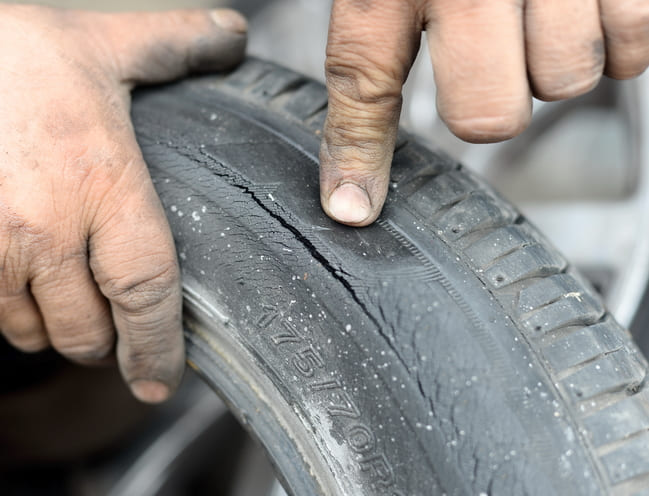
In the UK, tyres with sidewall damage or significant wear are considered illegal and unsafe to use on the road. Sidewall damage, such as cuts, bulges, or punctures, weakens the tyre's structure, increasing the risk of a blowout. Unfortunately, it is not possible to repair sidewall damage regardless of the severity due to the complex nature and risk of internal damage.
Driving illegally not only endangers your safety but also results in fines and penalty points. Regularly check your tyres for damage or wear to ensure they meet UK legal requirements.
Over- or under-inflated tyres
Over- or under-inflated tyres are considered very dangerous. Over-inflation can lead to reduced traction, increased risk of tyre blowouts, and uneven wear, while under-inflation causes the tyre to overheat, leading to poor handling and excessive wear on the outer edges.
Both cases compromise braking performance and stability, making your vehicle more difficult to control, particularly in harsh weather. Ensuring your tyres are properly inflated according to the manufacturer’s specifications is crucial for safety, legality, and optimal vehicle performance.
Always check the pressures regularly and compare them to the values specified by the manufacturer. These can be found on the door jamb sticker or in the owner’s manual. For off-road tyres, the pressure is typically on the lower side, falling between 15 to 30 PSI, but this may depend on the terrain.
Sold by AUTODOC Sold by AUTODOC Sold by AUTODOC Sold by AUTODOC Sold by AUTODOC
Gripmax Status PRO W

 Article number
 B
72 dB
£83.99
Price per item
£335.96 / Price per 4 items
price incl. 20% VAT, free delivery
Lanvigator Catchfors A/S
B
72 dB
£83.99
Price per item
£335.96 / Price per 4 items
price incl. 20% VAT, free delivery
Lanvigator Catchfors A/S

 Article number
B
71 dB
£38.99
Price per item
£155.96 / Price per 4 items
price incl. 20% VAT, free delivery
HI FLY HF805
Article number
B
71 dB
£38.99
Price per item
£155.96 / Price per 4 items
price incl. 20% VAT, free delivery
HI FLY HF805

 Article number
B
72 dB
£70.99
Price per item
£283.96 / Price per 4 items
price incl. 20% VAT, free delivery
Tristar All Season Power
Article number
B
72 dB
£70.99
Price per item
£283.96 / Price per 4 items
price incl. 20% VAT, free delivery
Tristar All Season Power

 Article number
B
71 dB
£87.49
Price per item
£349.96 / Price per 4 items
price incl. 20% VAT, free delivery
-34%
Bridgestone Weather Control A005
Article number
B
71 dB
£87.49
Price per item
£349.96 / Price per 4 items
price incl. 20% VAT, free delivery
-34%
Bridgestone Weather Control A005

 Article number
 B
71 dB
compared to
RRP
£173.12
£112.99
Price per item
£451.96 / Price per 4 items
price incl. 20% VAT, free delivery
B
71 dB
compared to
RRP
£173.12
£112.99
Price per item
£451.96 / Price per 4 items
price incl. 20% VAT, free delivery
Mixing different tyre plys
Mixing different tyre ply types (such as radial and bias-ply tyres) on the same axle is illegal and unsafe. Radial tyres have steel belts for better strength and performance, while bias-ply tyres have layers of fabric and rubber, offering less stability and control.
Mixing these types can lead to uneven wear, reduced handling, and compromised safety, especially when cornering or braking. To ensure your vehicle remains roadworthy and legal, always fit matching tyres of the same type and specifications on each axle.

What will happen if I drive with illegal tyres? Fines & penalties
In the UK, driving with illegal tyres can lead to significant fines and penalties. If caught, you could face a fine of up to £2,500 per tyre and 3 penalty points on your licence. In severe cases, you could be banned from driving.
Additionally, driving with unsafe tyres increases the risk of accidents, potentially leading to higher insurance premiums or invalidating your coverage. Always ensure your tyres meet legal requirements to avoid these risks and ensure safety on the road.

How to choose the right tyres
To select the correct tyres for your specific vehicle, you should only buy tyres with the same specifications as those listed in your car owner’s manual. For example, if the manual says you need the same tyre width, aspect ratio, diameter, and construction type.
It is okay to buy models with a higher load index or speed rating, but you should never buy those with a lower index or rating as this increases the risk of a blowout when driving.
Top products related to this topic: