Table of Contents

 30 January 2025
 Tyre wear indicator: what is the limit in the UK?
Understanding when to fit new tyres to vehicle is essential for safety, as tyres that are too worn cannot provide proper grip on normal or slippery roads. Tyre wear indicators help drivers monitor tread depth, ensuring they meet the legal minimum in the UK. In this blog, we’ll explore the wear limits, indicators, and why maintaining a proper tread is crucial for safe driving.
What are tyre tread wear indicators?
The wear indicators are usually markings that are evenly spaced across the main grooves of the tread. If they are visibly level with the tread pattern, you should replace the tyres right away as this indicates that they are too worn and have reached the legal minimum depth.
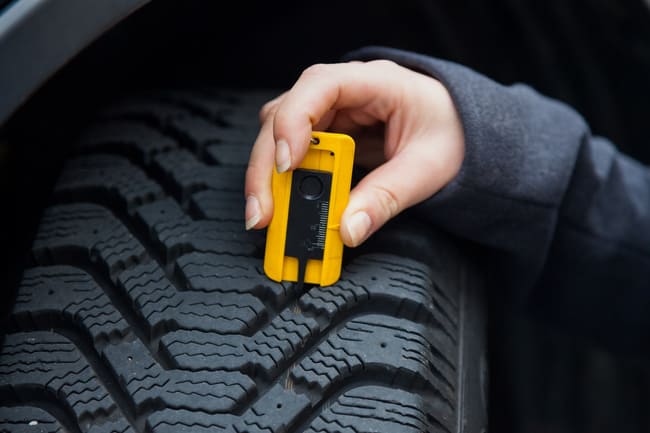
They promote safer driving by helping drivers maintain proper tyre performance, grip, and compliance with road safety regulations.You can also measure the depth yourself using a tread depth gauge or 20p coin.
Recommended Article
Nail in tyre repair: puncture repair costs and what to do for tyre damage
How to find the wear indicators on your tyres
Locate tyre wear indicators by inspecting the grooves of the tread. Look for small raised bars running across the grooves, evenly spaced around the tyre. Many tyres also feature a sign on the sidewall, such as a triangle, "TWI," or a logo, to help identify indicator locations easily.
Do all tyres have wear indicators?
Yes, all modern tyres manufactured for passenger cars, light trucks, and smaller commercial vehicles are made with wear indicators as a standard safety feature. These small bars along the tyre tread provide a visual cue when the tread reaches the minimum legal depth, typically 1.6 mm in the UK. They help ensure compliance with safety regulations.
Sold by AUTODOC Sold by AUTODOC Sold by AUTODOC Sold by AUTODOC Sold by AUTODOC
Vredestein T-Trac 2

 Article number


 B
69 dB
£85.99
Price per item
£343.96 / Price per 4 items
price incl. 20% VAT, free delivery
-40%
Toyo Proxes R888R
B
69 dB
£85.99
Price per item
£343.96 / Price per 4 items
price incl. 20% VAT, free delivery
-40%
Toyo Proxes R888R

 Article number
 B
71 dB
compared to
RRP
£255.97
£151.99
Price per item
£607.96 / Price per 4 items
price incl. 20% VAT, free delivery
-47%
Toyo Proxes R888R
B
71 dB
compared to
RRP
£255.97
£151.99
Price per item
£607.96 / Price per 4 items
price incl. 20% VAT, free delivery
-47%
Toyo Proxes R888R
 Article number
B
71 dB
compared to
RRP
£262.57
£137.99
Price per item
£551.96 / Price per 4 items
price incl. 20% VAT, free delivery
Maxxis Premitra 5
Article number
B
71 dB
compared to
RRP
£262.57
£137.99
Price per item
£551.96 / Price per 4 items
price incl. 20% VAT, free delivery
Maxxis Premitra 5

 Article number

 B
70 dB
£88.99
Price per item
£355.96 / Price per 4 items
price incl. 20% VAT, free delivery
Maxxis Mecotra 3 ME3
B
70 dB
£88.99
Price per item
£355.96 / Price per 4 items
price incl. 20% VAT, free delivery
Maxxis Mecotra 3 ME3
 Article number
B
69 dB
£71.49
Price per item
£285.96 / Price per 4 items
price incl. 20% VAT, free delivery
Article number
B
69 dB
£71.49
Price per item
£285.96 / Price per 4 items
price incl. 20% VAT, free delivery
How to check the tyre wear indicator
To check the tyre wear indicator:
- Locate the markings: look for "TWI" markings, triangles, or logos on the tyre sidewall, which point to the wear indicators within the tread grooves.
- Inspect the tread: examine the grooves near these markers. If the tread is flush with the indicators, it’s time to replace the tyre.
- Repeat across tyres: check all 4 tyres as wear may vary due to alignment issues or driving habits.
Alternatively, you can check the depth yourself by inserting a car tread depth gauge into the main grooves and noting down the reading. The readings should be above 1.6 mm deep. If they have reached the minimum tread depth or are below it, new tyres should be fitted.
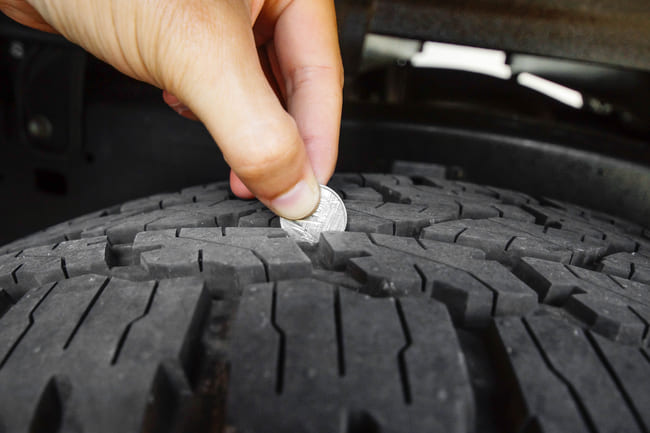
You may also be able to measure the depth by inserting a 20p coin into the tread.If the outer rim of the coin is visible, it may be too shallow.
What's the minimum tread depth for tyres in the UK?
The minimum tread depth in the UK is currently 1.6 mm across the central 3/4 of the tyre's width and around its entire circumference. It is illegal to drive with tyres that are worn beyond the limit and doing so may result in a fine and penalty points on your licence.
It’s also not worth the risk to your safety and the safety of others as worn tyres can cause the vehicle to skid out of control.
Sold by AUTODOC Sold by AUTODOC Sold by AUTODOC Sold by AUTODOC Sold by AUTODOC
-44%
Toyo Proxes R888R
 Article number
B
71 dB
compared to
RRP
£349.33
£193.99
Price per item
£775.96 / Price per 4 items
price incl. 20% VAT, free delivery
Minerva ALL SEASON MASTER XL
Article number
B
71 dB
compared to
RRP
£349.33
£193.99
Price per item
£775.96 / Price per 4 items
price incl. 20% VAT, free delivery
Minerva ALL SEASON MASTER XL

 Article number
B
71 dB
Article number
B
71 dB
 £72.99
Price per item
£291.96 / Price per 4 items
price incl. 20% VAT, free delivery
Maxxis Premitra AS AP3
£72.99
Price per item
£291.96 / Price per 4 items
price incl. 20% VAT, free delivery
Maxxis Premitra AS AP3
 Article number
B
71 dB
£86.49
Price per item
£345.96 / Price per 4 items
price incl. 20% VAT, free delivery
Maxxis Premitra All Season
Article number
B
71 dB
£86.49
Price per item
£345.96 / Price per 4 items
price incl. 20% VAT, free delivery
Maxxis Premitra All Season
 Article number
B
71 dB
£113.49
Price per item
£453.96 / Price per 4 items
price incl. 20% VAT, free delivery
-36%
Toyo Proxes R888R
Article number
B
71 dB
£113.49
Price per item
£453.96 / Price per 4 items
price incl. 20% VAT, free delivery
-36%
Toyo Proxes R888R
 Article number
B
70 dB
compared to
RRP
£199.60
£125.99
Price per item
£503.96 / Price per 4 items
price incl. 20% VAT, free delivery
Article number
B
70 dB
compared to
RRP
£199.60
£125.99
Price per item
£503.96 / Price per 4 items
price incl. 20% VAT, free delivery
Should you wait until you reach the legal limit to change your tyres?
Most manufacturers recommend that you replace the tyres before the legal limit for tyre treads is reached. As a general rule, drivers are advised to fit new tyres once it is around 3 mm just to be on the safe side. At 3 mm, tyre performance, especially grip and braking efficiency, starts to noticeably decline.
You also may need a replacement if there are signs of uneven wear, punctures, cracking, or tears. Damage to the sidewall in particular cannot be repaired.
Recommended Article
Car tyre speed rating: table, meaning, and differences
Should you always replace the tyres in pairs?
You should replace both tyres on the same axle at the same time. While it may be tempting to only replace one tyre if only one is badly worn, it is generally advised against due to potential imbalances in grip and rolling resistance, affecting the steering.
In the case of all-wheel drives, you may even need to replace all four tyres at once. Make sure to check your vehicle’s owner’s manual for specific recommendations and specifications.
Top products related to this topic: